In the symbols of ownership survey I asked people about how and when they wore their symbols of BDSM ownership.
210 people did the survey and 177 answered this question. 10 said they were Tops, 19 Bottoms, 61 – Dominants, 116 – Submissives and 22 identified as switches.
Their answers were as follows:
Top
Bottom
Dominant
Submissive
I have no symbols of ownership.
70%
32%
70%
15%
I wear them all, all the time?
20%
5%
26%
11%
I wear some of them, some of the time?
5%
18%
I wear some of them all the time?
5%
21%
All of them visible when wearing normal clothing
2%
8%
Some are visible when wearing normal clothing
10%
16%
2%
18%
None aree visible when wearing normal clothing
2%
I only wear them/show them in BDSM settings
37%
8%
I’ve highlighted the most common answer in each column in blue and the second most common in red.
They are charted below.
Key points
Tops and dominants are equally likely NOT to have any symbols of ownership (70%) but, when they did, they wore them all the time (20% – T and 26% – D).
Bottoms and submissives were more likely to wear some symbols of ownership (32% of bottoms and only 15% of submissives had NO symbols of ownership) but a relatively low percentage wore them all the time (5% – B, 11% – S).
Bottoms and switches were more likely to only wear symbols of ownership in a BDSM setting (37% – B, 45% – Sw)
If you found this interesting or useful, please think about doing the BDSM and Money survey, on the impact of BDSM on people’s pockets. Current results will be visible once you have completed the survey
We’d stopped to pick up pet food and decided we’d grab some supper from the supermarket a few doors away. As we walked, I’m sorry to say I fell into my usual habit – but before he could say “shoulders BACK!” I got in first.
‘Hang on, your shoelace is undone – you might trip over it’.
He stopped, turned and moved his foot forward.
Never let it be said I can’t take a hint: I knelt and tied the lace, nice little bow, pat on the leg to indicate ‘all done’. And we walked on.
Was anyone looking? Didn’t seem to matter. I don’t think they’d have been offended.
Can’t remember what we got for supper but I do remember the first lolly of the year – a Magnum, I’m afraid. Still. sharing it means I didn’t quite blow the diet.
I’ve taken the data referred to here from the responses of the 210 people who responded to my BDSM ownership and symbology survey, done through surveymonkey.
However, my earlier “BDSM styles and relationships” survey had a question on this as well – I’ll add data from the much larger response to that survey to this blog when I have time.
I’d prefer to talk about this data as relating to multiple, rather than polyamorous or “poly” relationships, because I’d define the latter as transparent to all and mostly with respect and affection between all parties. There was no way of knowing whether this was the case or not for most of the answers.
So, in the BDSM ownership and symbols survey we asked people to choose from six options that defined their relationships. Here are the responses, charted and as a table.
Sadist/Masochist
Dominant/Submissive
Master/Slave
I am not in a relationship
36%
14%
6%
I have one partner ( not BDSM)
4%
I have one partner (BDSM)
31%
54%
67%
I have multiple partners and my primary relationship is BDSM
5%
13%
13%
I have multiple partners and my primary relationship is not BDSM
17%
11%
2%
I am in more than one relationship of equal status
12%
4%
13%
It’s important to point out that only 42 S/m people 114 D/s respondents and 48 who said they were M/s answered the question.
Those who said their BDSM component was S/m were much more likely to be single (36%) than the other two groups.
M/s people (67%) and D/s people (54%) were more likely to be in a monogamous relationship. A third of S/m people were in more than one relationship. This was slightly higher than both the other groups, where 28% (D/s) and 27% (M/s) had more than one partner.
Safewords give confidence to people who are new to topping and bottoming and help experienced people who are new to each other understand each other better. They are a sensible approach to safety and have been seen as essential certainly for as long as I can remember.
I am not going to use the argument that safewords can’t protect anyone from abuse by a determined abuser. The same is, sadly, likely to be true of any system designed to preserve consensuality and safety. Abuse of safewords does take place and needs to be exposed. No, my view is that, for some, there are alternatives to safewords that may be as effective, but more rewarding..
Safewords halt scenes that are going wrong, but are they a bit of a sacred cow? Are there other ways of ensuring safety and making submission feel as real as possible? Could other ways sometimes be better? I think so.
(Photo credit: Wikipedia)
Safety and consensuality
I understand that something like a safeword is essential to preserve consensuality in a scene and I have absolutely no doubt that there needs to be communication between top and bottom, dom and sub to ensure safety, but I think “take care”, “stop” and “no” are better than a dedicated safeword.
For me, safewords undermine dominance and submission and they turn play into play acting. They can also become an excuse for abuse.
The sub in control?
In many circumstances, it’s my belief that safewords diminish the experience for all.
Why? Well:
There she is, moaning, groaning and pleading and all of a sudden she says “Amber”. Instantly, you know all that moaning, groaning and pleading was false. Just acting (ok – with feeling, but you suddenly know what you were doing was not having the effect you thought)
She “Ambers” again; things get better and maybe you get a “Green” of pleasure… You screw up and she utters a sudden, shouted “RED”. And you realise it isn’t just the moaning that was false. There’s no submission either. She is in control of the scene. She decides what she receives.
Of course, it’s a little less true if you use a single safeword that always brings things straight to a halt. That way all that is controlled is the end of the scene. That seems sensible to me (but see below), rather than providing the submissive with a tool that can be used to take control, which is what the RAG system, I feel, does. but, if that is your choice, why use a special, secret word, and not just allow people to communicate their needs. It seems to me that people want the freedom to say “please stop” when it’s not what they mean.
There she is strapped down securely. Cheeks and shoulders beginning to glow as you get into the rhythm a good flogging requires (and which for me, produces it’s own zen-like satisfaction). I know she has a safeword. Therefore, I can do what the hell I like, because she has the responsibility of choosing when to stop. And, she can’t blame me for getting it wrong – because she had her safeword to use!
And for the submissive?
“Well, if I safeword, I’ve failed him, haven’t I. Oh I mustn’t safeword – he won’t be proud of me at all. I must be the best I can be.”
Or,
“I can’t space, it might not be safe, I won’t know what’s happening: I might need to safeword.
Another way to safety?
(Photo credit: Wikipedia)
So for me, ensuring safety in a scene comes down to these things:
Real communication, using real language – Then the moans and the pleading are real and satisfying. And, “STOP” means stop.
The dominant should not have power without responsibility – which is what a safeword can give. Instead, he should observe his submissive and communicate with her. Watch her, check she’s ok, check her ability to communicate, her breathing, her mental state – whether she’s drifted away into subspace.
The result, the submissive enters the scene knowing she has given herself to her dominant within the limits they have agreed and her only responsibility is to be the best she can be. The dominant knows he is free to use her – and that the responsibility for making it a satisfactory time for both is his. She is the instrument, he is the musician.
Fuller results from the poll below can be found in an article lined tto under “related links” at the bottom of this post.
“To be thrilled at the touch of leather, aroused by the sound of harsh words, or satisfied by the security of rigid bondage is the mark of a lover.
“To be thrilled at the opportunity to provide useful service, aroused by a pleased nod, and satisfied by the proverbial job well done, is the mark of a slave.
“It may sound severe. Almost anti-erotic. Until you see two people, owner and owned, existing in a complementary relationship where each suits the other like balances on a delicate scale. Until you feel the energy of their rapport, you cannot understand how they fulfil each other, take and give in ways no negotiation could possibly express.”
This means much to me. I don’t use the word slave of my submissive partner, but I do understand there are those who use it and for whom it is real. If you’ve read Fifty shades and found a small yearning for an asymmetric life as well as S/m bedroom play, then I think you should, bi, gay or straight, give “The Marketplace” a go. It will give you a very different view of dominance and submission.
The quote at the top expresses, very closely, for me, the difference between 50 Shades of Grey”s primarily erotic BDSM relationship and one based on service and responsibility.
I respond to the balance of owner and owned.
I should also emphasise that my thinking does not encompass inequality in the way some do – I think of my partner and myself as equal but opposite.
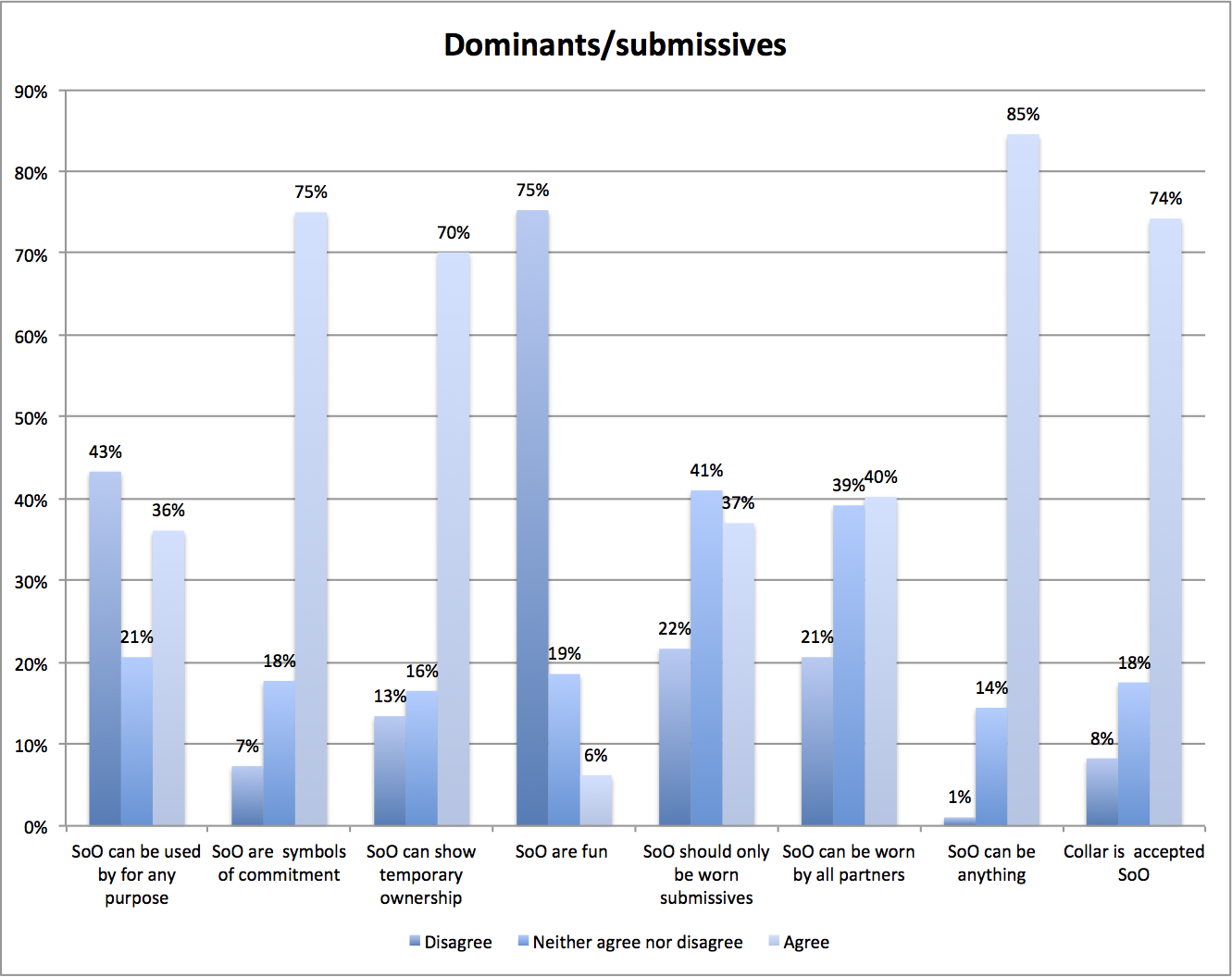
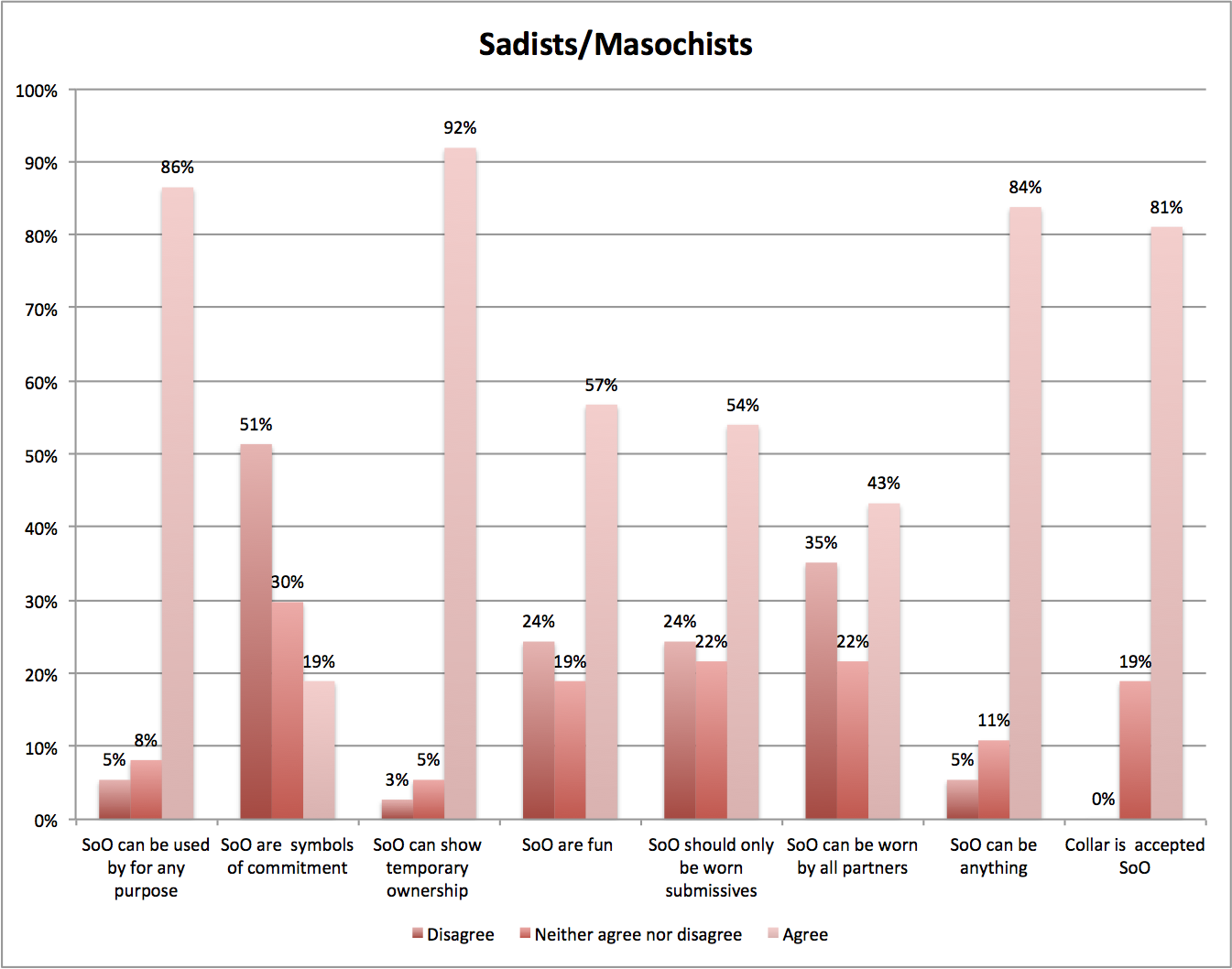
In my BDSM ownership and symbols survey, 43 Master/slaves (M/s) participants answered the following question:
Thinking of symbols of ownership in BDSM, to what extent do you agree with the following statements?
Their responses to each of the question’s statements are below:
Symbols of ownership can be used by anybody in any BDSM dynamic, for any purpose
72% of M/s people disagreed with this (58% strongly). 14% of M/s people agreed. and 14% were neutral.
Symbols of ownership are important symbols of commitment and permanence and should be worn and respected as such.
86% agreed (70% strongly). 7% were neutral and 7% disagreed.
Symbols of ownership can be worn to indicate temporary ownership (for example in play sessions)
35% agreed (just 5% strongly agreed); 30% were neutral and 35% disagreed (which meant they thought it was ok).
Symbols of ownership are fun and have no other special significance
Only 7% agreed (none agreed strongly). 5% were neutral. 89% disagreed (77% strongly)
Symbols of ownership should only be worn by the submissive partner(s)
54% agreed. 40% responded neutrally and 21% disagreed.
Symbols of ownership can be worn by all partners
23% agreed (2% strongly). 23% were neutral and 249% disagreed (35% strongly disagreed)
A symbol of ownership can be anything the partner(s) agree on
84% agreed (the same as D/s respondents, but slightly more agreed strongly, 51% of M/s respondents as against – 44% of D/s people), 12% responded neutrally and 4% disagreed.
A collar is the accepted BDSM symbol of ownership.
86% agreed (63% strongly). . 14% were neutral and none disagreed!
If you found this interesting or useful, please think about doing the BDSM and Money survey, on the impact of BDSM on people’s pockets. Current results will be visible once you have completed the survey
If you found this interesting or useful, please think about doing the BDSM and Money survey, on the impact of BDSM on people’s pockets. Current results will be visible once you have completed the survey
If you found this interesting or useful, please think about doing the BDSM and Money survey, on the impact of BDSM on people’s pockets. Current results will be visible once you have completed the survey
English: Erotic scene. Rim of an Attic red-figure kylix, c. 510 BC. Français : Scène érotique. Bord d’un kylix attique à figures rouges, vers 510 av. J.-C. (Photo credit: Wikipedia)
Or, why I like anal sex First and foremost, if I am honest, is the sensation. I can be greedy, of course, and feelings of deep satisfaction (for him as well as me, I hope) are very much desirable.
At the start, the over-riding feeling if a certain fullness – one good reason to be as “empty” as possible from the beginning – and warmth: not the same heat as my lotus, and not as damp, either – but definitely balmy.
But I rush on – so much of the pleasure is before he has even started. From the moment his mouth curves into that special, thoughtful smile, I know what he is going to say. “I’m going to bugger you”. I just want to melt into a little puddle. Or a big one.
Then the lube, carefully warmed on my finger-tips, and generously applied to both tip and shaft. The pleasure of touching him, stroking him, encouraging him – the opportunity for such a personal closeness.
I am just glowing. He will often roger me first, which is wonderful in its own way, and very special. But I know he is almost teasing till the right moment comes, when he says, simply, “turn over”. Then it’s a matter of kneeling, lowering my hips and waiting – sometimes for gentle probing with fingers before the pressure against the sphincter as his cock demands entry, others for an immediate total insertion which feels as if I’ll be torn open but which also makes me feel more submissive than almost anything else. You know, of course, that there are many extra nerve ending there – so anal coitus can be even better than vaginal. And there is the added fillip of being on my knees – though I miss seeing his face! We are experimenting with ways of dealing with this… Then of course there is the “naughty” aspect – by which I mean the taboo of using the dirt road. Perhaps this is the result of a Welsh Baptist upbringing – but it becomes irrelevant in the face of his pleasure. And mine. Did I mention I was greedy?
So – there you have it: anal sex. I’m on my knees, it’s naughty, it makes my bits sore, it’s all about his pleasure. What’s not to like?
Kneeling and waiting for him to decide the how and where of penetration is a challenge, even though I have already consented to “anywhere”. Even when he has announced his intention to bugger me, it is always in his power to change his mind and decide instead to use my mouth or lotus.
Of course, he could decide not to touch me at all. I am learning on a basic level simply to accept: my desires and preferences are irrelevant, unimportant until he decides otherwise.
In terms of my submission, there is another element – and this is linked to pleasing him. I shiver to hear “good girl” at any time, but now there is an absolute fountain of joyous bubbles rising inside me as i hear him say “clever bottom”. For me, it is not enough to give him access and measure my submission by my own standards of generosity. For it to ‘work’, it has to be as complete as possible (or as complete as it can be in our circumstances) and as perfect as we can make it. So I practice – pelvic floor exercises and clenches, not just for the vaginal muscles but also for the rear. When he is taking my bottom, I will try to massage him with gentle muscle squeezes. In a way, this distracts from my pleasure and once again makes it all about his, which is the way we like it.
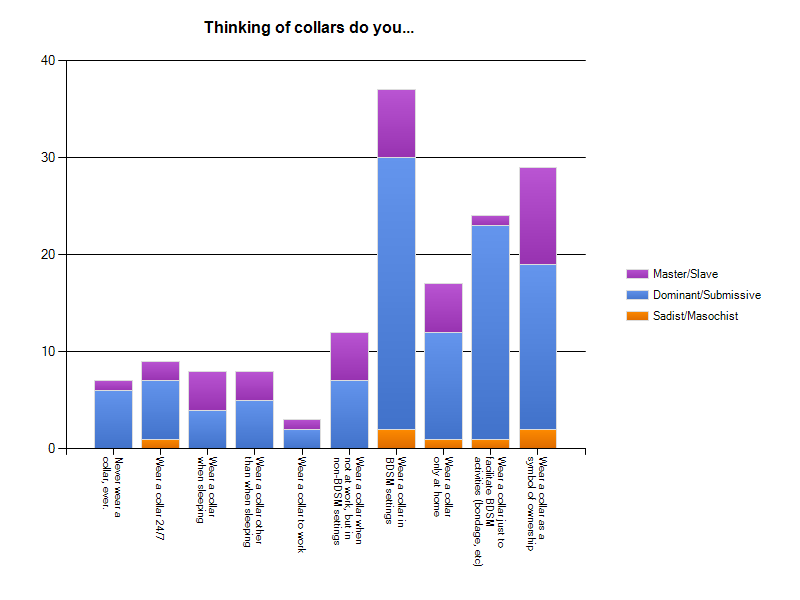
In the survey I did of BDSM symbols and ownership, promoted through my blog and posts on the website Informed Consent, I asked about people’s collar-wearing habits.
Who answered
68 submissive respondents answered this question. Four were masochists, 49 said they were submissives and 15 identified as slaves. 17 people skipped the question. People could choose more than one response.
Collar wearing
Half of the masochists (two people) said they wore a collar as a symbol of ownership. 35% of submissives and 67% of slaves said they wore a collar as a symbol of ownership. None of the masochist respondents said they “Never wear a collar, ever” whilst 12% of submissives and seven per cent of slaves said they never wear a collar.
Clicking on this image opens a larger one which may be more easily readable.
24/7?
25% of masochists (Okay – one person) said they wear a collar all the time, compared to 12% and 13%, respectively, of submissives and slaves. This contrasts with those who wear a collar just for BDSM purposes – 25% of masochists, 45% of submissives and 7% (that’s just one person) of slaves do this.

 In the symbols of ownership survey I asked people about how and when they wore their symbols of BDSM ownership.


 In my
In my 


 A dominant and submissive life