Get a picture of your kink

standing stoneJust for fun, I’ve uploaded a BDSM “dashboard” that might help you analyse your own kink or that of others.

I created it a while back, using the list of kink options that the UK BDSM website “Informed Consent” used. I may update this. It’s not a BDSM checklist it’s more a look at how you feel about BDSM stuff right now.

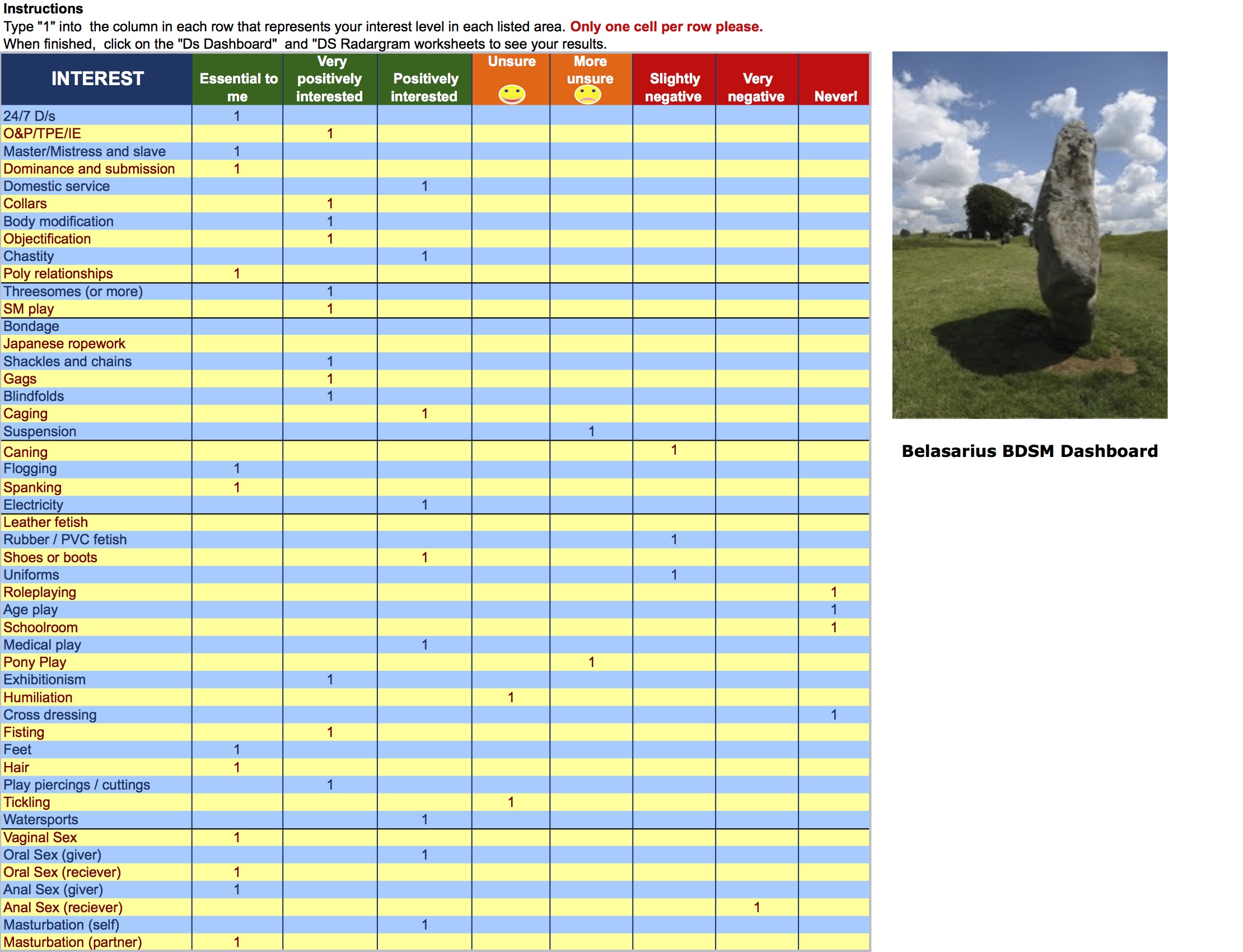
The first thing you need to do is make some choices. In the first tab of the spreadsheet, put “1” into the column that most resembles your attitude to a particular fetish, type of play or BDSM lifestyle element.

The input screen looks like this:

Dash1

Anyway, after a minute (or less) inputting on the first tab of the spreadsheet, you are done and clicking on the second tab, this is what you get: A radargram of your kink.

Dash2

And, then, a tab that gives you two charts (example below), a table of your scores and some ideas of what they may mean (remember there is no science here, it’s just fun).

Dash3The charts above are my results by the way (though I may change – I can be a capricious fellow).

So – do you want to have a go? Here’s the download: Belasarius_BDSM_dashboard1 (it’s an .xls Excel file).

How the ratings work

You end up with percentage scores (which can be negative) for each of:

  • L – a percentage ranking of your interest in lifestyle D/s topics listed in IC profiles. The higher the score, the more these aspects interest you – max score: 100%
  • P – a percentage ranking of your interest in play practices listed in IC profiles. The higher the score, the more these things interest you – max score: 100%
  • K – A percentage ranking (max 100%) taken from all the items listed on IC profiles: It says more about how wide your interests are than the depth and strength of your deviancy
  • KQ – (Kink quotient) the average of all three scores above – (max 100%): compare this with the other scores for an idea of where your main interests lie – and just how kinky you are!

What the ratings mean

Well, not a lot really, you will have your own view. But here are a few score combinations and my interpretation:

  • 41/28/52/40 – Someone whose interests in lifestyle issues strongly outweigh play, but who has a wide range of other interests and some strong kinks (examine the radar diagram to see what)
  • 36/47/44/42 – someone with a balance of lifestyle and play interests, but not hardcore in in any area.
  • 12/55/66/44 – someone who wants scene play far more than they want a D/s life – and who plays hard.

Is it useful?

Up to you guys really – it might be a useful discussion point for people exploring a new dynamic.

It’s very limited – it says nothing about dominance and submission at all, for example.

Feel free to share it, but please link and credit me if you do.

Oh, and, anyone fancy taking part in my BDSM definitions polls?

Dominant’s and submissives – what do you call your partners?

standing stoneUPDATE: these polls are now closed. A short article on the results is here. These two polldaddy polls are inspired by this thread, on labels, from UK BDSM website StrangelyNormal.

No more than a bit of fun!

Please do only one of the polls, depending on whether you see yourself mostly as dom or sub. If you are a 50/50 switch, feel free to do both. You can tick all the options you feel apply to you. The “Dominants…” poll is for dominants and the “Submissives…” poll is for submissives.

Oh, and comment away to your heart’s content too.

If you fancy pressing a few more buttons this link will take you to the polls I am running on definitions of BDSM terms.

Happy polling, and thanks!

Safeword Survey – does a safeword make play feel more artificial?

This article looks at how strongly 499  acedc11cbeb3a2a0b4e3bca15378bec4safeword survey participants agreed or disagreed with the statement “I feel a safeword makes my play more artificial”.

The first chart, shows the extent to which all respondents (split by gender) agreed or disagreed with the statement “I feel a safeword makes my play more artificial” (the method I have used for calculating the charts is under the subheading “Data used in this article” below).

SWArtificial1

Respondents of both genders were more likely to agree than disagree with this statement. Men were slightly less likely to agree than women, but both sexes agreed,  by a substantial margin, that safewords made play more artificial.

SWArtificial2

When the data was split by BDSM orientation (above) a clear difference did emerge. Switches were roughly three times more likely to disagree that safewords make play more artificial whilst both tops/dominants and bottoms/submissives supported the statement strongly. Tops/dominants were more than four times more likely to agree that safewords make play artificial. Bottoms/submissives also agreed – but not as strongly. They were only twice as likely to agree that safewords make play artificial than to disagree.

Perhaps unsurprisingly, people from the Master (mistress) & slave BDSM component overwhelmingly agreed (roughly 12 times more likely to agree with the statement than to disagree with the statement – below). People from the largest group in the survey (Dominants/submissives were split and Sadists/masochists were a little more likely to disagree that safewords make play feel artificial than not.

SWArtificial3

Data used in this article

The article uses data from a question where people were asked whether they felt that a safeword made their play more artificial. 499 people answered the question. People were able to pick from the following responses:

  • Agree
  • Agree strongly
  • Neither agree nor disagree
  • Disagree
  • Disagree strongly

To produce the charts used above I manipulated the data as follows:

  • Agree (scored 1)
  • Agree strongly (scored 2)
  • Neither agree nor disagree (eliminated from responses)
  • Disagree (scored -1)
  • Disagree strongly (scored -2)

I totalled the  scores and then divided that by the total of all responses (including “Neither agree nor disagree”, in order that a high neutral response would influence the outcome by reducing both negative and positive scores). I expressed that in percentages for convenience.

The data used is in the tables below:

What is your gender? (All) I feel a safeword makes our play more artificial
What is your BDSM orientation? How would you describe the most important component of your BDSM Dynamic? Agree Agree strongly Disagree Disagree strongly Neither agree nor disagree Grand Total
Bottom/Submissive Dominant/Submissive 36 44 48 38 23 189
Master/Slave 9 33 2 4 7 55
Sadist/Masochist 9 3 9 6 4 31
Bottom/Submissive Total 54 80 59 48 34 275
Switch Dominant/Submissive 2 2 13 17 13 47
Master/Slave 2 1 1 0 2 6
Sadist/Masochist 11 1 10 4 11 37
Switch Total 15 4 24 21 26 90
Top/Dominant Dominant/Submissive 12 23 18 20 10 83
Master/Slave 4 19 2 1 1 27
Sadist/Masochist 3 2 3 10 6 24
Top/Dominant Total 19 44 23 31 17 134
Grand Total 88 128 106 100 77 499
What is your gender? Male I feel a safeword makes our play more artificial
What is your BDSM orientation? How would you describe the most important component of your BDSM Dynamic? Agree Agree strongly Disagree Disagree strongly Neither agree nor disagree Grand Total
Bottom/Submissive Dominant/Submissive 14 7 7 3 10 41
Master/Slave 1 1 0 1 2 5
Sadist/Masochist 4 0 2 0 2 8
Bottom/Submissive Total 19 8 9 4 14 54
Switch Dominant/Submissive 1 2 9 9 8 29
Master/Slave 0 0 0 0 2 2
Sadist/Masochist 3 1 6 0 9 19
Switch Total 4 3 15 9 19 50
Top/Dominant Dominant/Submissive 10 17 11 15 6 59
Master/Slave 3 13 2 1 1 20
Sadist/Masochist 3 1 2 5 5 16
Top/Dominant Total 16 31 15 21 12 95
Grand Total 39 42 39 34 45 199
What is your gender? Female I feel a safeword makes our play more artificial
What is your BDSM orientation? How would you describe the most important component of your BDSM Dynamic? Agree Agree strongly Disagree Disagree strongly Neither agree nor disagree Grand Total
Bottom/Submissive Dominant/Submissive 22 37 39 34 13 145
Master/Slave
Sadist/Masochist 3 3 3 3 3 3
Bottom/Submissive Total 34 34 34 34 34 34
Switch Dominant/Submissive 2 2 2 2 2 2
Master/Slave 1 1 1 1 1 1
Sadist/Masochist 4 4 4 4 4 4
Switch Total 7 7 7 7 7 7
Top/Dominant Dominant/Submissive 4 4 4 4 4 4
Master/Slave
Sadist/Masochist 2 2 2 2 2 2
Top/Dominant Total 6 6 6 6 6 6
Grand Total 47 47 47 47 47 47

Equality in an asymetric relationship

acedc11cbeb3a2a0b4e3bca15378bec4On equality (from this thread on the old Informed Consent website):

Me and my girl are equal. No doubt.

There is huge respect between us. We value each other as people, we see the world through different eyes and argue our corners.

But we are opposite. And have found a way to make that oppositeness create energy and strength.

She submits. I don’t: She strives to please me. Pleasing me pleases her.

I adore her. I push, pull, mould her to make her more of herself – the self I see, that she has wanted to be all her life but has not had the chance to be.

Equal. Yes.

Opposite – definitely.

Putting the other first – absolutely.

Both getting what we need? Indeed.

Related articles:

BDSM protocol – a definition

Belasarius

This, my first attempt at a BDSM definition in a while, was prompted by these originally similar threads started by @WayneKing:

Here’s what I think BDSM protocol may be:

“BDSM protocol is  an enduring, habitual, non-verbal expectation of behaviour that people in a consenting BDSM dynamic do for each other whenever it is appropriate to do so, as defined by their rules.”

The “non verbal expectation” is, I think, fundamental and that is @WayneKing’s idea: many thanks.

CurtseyPlease use the poll below to vote on whether you think this definition is right and, if you don’t, please do comment. I will try to incorporate others’ ideas into future versions of the definitions.

Further definitions (and polls) are on this page, which links to articles on each definition.

Our protocols

Belasarius

Protocol is what I demand of her that is related to the expression of our BDSM dynamic, rather than our relationship. I see protocol as enduring, habitual, prescribed actions that people in BDSM dynamics do for each other whenever it is appropriate, as defined by their rules.

WayneKing defined protocol as “a non verbal expectation of behaviour” and I couldn’t agree more.

So, protocol doesn’t determine that I might give her a hug, or that we might have a row over something trivial, but it does mean, that if we are at home when hugging or arguing occurs that she will be naked. I’d say that the rule that she has no right to deny me use of her body, within our limits, is part of our dynamic – but not a protocol.

Our basic protocols are:

c. 1530

  • She is pink at home, unless I allow otherwise.
  • She asks permission to leave me, even to go into another room and waits until it is given.
  • She doesn’t use the personal pronoun in speech
  • She asks permission to perform bodily functions
  • She goes to bed when I ask her, not when she wants to.
  • She isn’t supposed to use furniture unless i say so but (memo to me) I’ve got a little lax on this.
  • She shaves her fou-fou regularly
  • She offers her bottom if she is in error without waiting for it to be required (this, of course depends whether she thinks she is in error or not and she is a bit of a barrack room lawyer)
There are things that seem more like ritual than protocol too. For example:
  • I don’t cut my own finger or toenails
  • I always brush and plait her at bed time
  • She removes my shoes when i get home.
  • We always eat from one plate, with one set of cutlery and feed each other not ourselves.

This post was previously made here on Fetbook, and referred to here, on Strangely Normal.

And here is a blog about quite a different sort of protocol, which might be useful in BDSM

Japanese protocol and BDSM – felis intorqueo’s blog.

Belasarius


Posted as a permanent record of a lost friend’s (broken_kitten, or felis intorqueo) thoughts, from IC:


I love protocol. Or rather, I love the idea of protocol. The problem I always find when trying to use it is that words have too much power and are too easily misconstrued. There aren’t any concrete guidelines for what is and isn’t acceptable. Found a potentially adaptable solution, though…


“The Japanese language has an honorific system made of suffixes. I think it’s great because it allows people to identify themselves by their relationships with others. One does not confer honorifics on oneself but become part of a web where your position is defined by those you know.


Here is a list of honorifics, closest English equivalents and their main usages:


  • San – People think this is the equivalent of Mr. or Mrs., but that’s not quite the case. San can also be used to refer to animals, especially by children. It’s genderless and used when speaking to, or about, someone your own age and status.
  • Sama – Used when talking to, or about, someone of higher status than you, either professionally or in terms of age. Like an older sister or a company boss.
  • Dono/Kyou – Lord/Lady. Not used much anymore, except in very formal business meetings.
  • Chan – Suffix used for females younger than you, or friends your own age.
  • Kun – Male suffix, same uses as ‘chan’.
  • Senpai – Used to refer to a senior co-worker.
  • Sensei/Kyoshi – Anyone who has more knowledge and experience than you, especially a teacher. Kyoshi is a less formal version of sensei.
  • Ka – Used for someone who is an expert in their field, like a manga artist (mangaka)
  • Iemoto – Even more formal version of ‘ka’, only really used in the formal arts like calligraphy.
  • Baka/Yarou – When used as a suffix, it means ‘moron’. Yarou is a ruder version.


Landscape in Moonlight by Kano Tan'yû
Landscape in Moonlight by Kano Tan’yû (Photo credit: peterjr1961)


So, I’d want to refer to another, more experienced sub as ‘senpai’, an equal to me as ‘san’, a superior as ‘sama’, a junior or a close friend as ‘chan’ or ‘kun’.


 Someone who was teaching me in a general sense might be ‘sensei’ or ‘kyoshi’, or ‘ka’ if they were an expert, like maybe at a rope demo. Someone I was being instructed by in ritual D/s, I’d want to call iemoto or ‘ue’.


 Someone I was with in a submissive role might be ‘sama’ or ‘dono’ depending on the depth and intensity of the submission. Casual play would probably be ‘sama’ (not that I ever do that!).


Were I to have a sub, I’d refer to them as ‘kun’, unless I wanted to humiliate them, in which case it would be ‘yarou’, which is probably closest to ‘asshole’. I’d want them to refer to me as kitten-kyou at all times.


The most important thing to remember is that you never bestow an honorific upon yourself. This is very rude. If someone uses an honorific you perceive as rude, you may question it but you must not ever refer to yourself with any kind of suffix.


If we had a similar system in a D/s setting where there were lots of people, maybe like a themed chatroom, it would mean that everyone would be able to express their place very accurately by reference to the way they refer to others. In addition, No-one would ever be able to award themselves a top (or bottom) position. A person’s position would be defined by the respect, affection, care and responsibility conferred on them by others.


I think that would be quite fun. Protocol is one of those things that varies so much between places and individuals that it is difficult to know how to talk to anyone in a D/s group setting – the Japanese system of honorifics seems ready-made for people like us.”


Staying awake

BelasariusMe: “Did you sleep well darling?”

She (de-plaiting): “Uh-huh, err, yeah”.

Me: “You mean you didn’t?”

She: “Well, you put me on my back and used my breast as a pillow”. (I do, they are plumptious)

Me: “But, darling, we do that most nights and you say you sleep ok?”

She: “Oh, I do. But last night you told me to stop snoring”. (I have no recollection of this)

Me (puzzled): “And…”

She: “AND… I had to keep myself awake because I was on my back and not allowed to snore”.286723


Consent Violations in BDSM

BelasariusI guess this is the flipside to some of  the attitudes revealed by my safeword survey – much of which shows a wide variety of attitudes to using safewords, from the more than 500 self-selecting people who responded.

I found this Dutch/Belgian study on consent violations in BDSM really interesting. Here is what the author said on Fetlife:

Last month KinkyMinds held a survey on consent violations in the Dutch (speaking). Not just about the prevalence of consent violations, but also about how consent violations were experienced, where they took place, if they were considered abuse, about doubts about scenes by other people, interventions in scenes, and about party safewords.

The results are, though more nuanced than the results by the NCSF , with some understatement, quite shocking. Almost 65% of all respondents have at least experienced one consent violation. And that’s just one stunning figure.

Below you can find the final conclusions in English and Dutch.

The full 30 page report and analysis is probably more interesting than just this brief summary and contains a lot more analysis and explores many relations between key concepts. The report available for download (PDF) in Dutch and English the KinkyMinds website.

I wish to thank all the respondents for their time to answer the survey questions, and Pluu, Marijke and Nichi for proof-reading the draft version. Special thanks also to Voleuse for doing the reliability analysis. Without you, the report would have read like a wet newspaper. Of course, all responsibiliity for the report is mine and mine alone.

The author, Guilty, further commented:

What is the frequency of consent violations in the Dutch (language) BDSM scene?

Often. The idea that consent is absolute in the BDSM-scene doesn’t hold. Consent is very important, but at the same time, it gets violated on a pretty large scale. Almost 65% of the respondents have experienced at least one type of consent violation. There are significant relations with gender, orientation and experience. Consent clearly is the norm, but not always actual practice.

How are these consent violations experienced by those involved?

Not always equally bad. “Just” 14,6% has experienced at least one bad consent violation and 20,6% has ever experienced a consent violation as abuse. But there are many cases that are not experienced as bad. Women experience more consent violations as abuse than men. Still, only a very small part of the respondents considered filing charges or actually did so.
In this sense too, consent is less absolute than often suggested. It is violated quite regularly, but that´s not always bad. Still, a substantial part of the respondents has experienced a bad consent violation.
Considering the frequency of consent violations and the fact that such violations aren’t always bad, it is a valid question if consent as ultimate division between BDSM and abuse holds up. Consent violations, to some extent, seem to be part of the game. Not necessarily intended, but neither something to be prevented at all costs (which might not even be possible)

How often do people doubt the consensuality of other peoples’ scenes?

Almost a third (28,9%) has doubted consent in scenes of other people, and that tends to make them feel bad. Their concerns are not entirely unjustified. Of the total population 13% has experienced an ignored limit, 5,9% an ignored safeword and 11,8% a scene gone too far at a party. The idea that parties are the ultimate safe place for a first scene is need of some reassessment too.

How often is intervening in other peoples’ scenes considered? And: How often do we actually intervene in other people’s scenes?

A large part of the people who have doubted consent in scenes of other people, has considered intervening. Only a part of them has actually done so. Notifying a DM or asking participants if they are still okay are the most prevalent interventions. Only a minority directly intervenes themselves. But even many of those that do not intervene, tend to discuss the situation first with other people or a DM before deciding not to intervene. There is no massive bystander effect regarding doubts of consensuality.

Can a party safeword contribute to preventing consent violations and doubts about consensuality

A majority of the respondents (60%) is of the opinion that a party safeword can contribute to preventing consent violations. And 7,1% of the respondents has felt the need for such a safeword for themselves. On the other hand, most consent violation do not happen at parties. The victims of ignored safewords at parties are of course the main beneficiaries of a party safeword, but even amongst them “only” 30% has felt the need for a party safeword themselves.
We may conclude that a party safeword can contribute, but certainly will not prevent all consent violations. The question remains if that would be necessary and desirable, as not all consent violation are bad. They seem to be part of the game, and perhaps other attendees should do well to keep that notion in mind as well. It might well be that they experience a possible consent violation as worse than the participants themselves. Nonetheless, there is a case for a more active and attentive DM-policy, beyond introducing a party safeword.

Recommendations

Parties who wish to retain a profile as being safe would do well to consider introducing a party safeword and to uphold an active, albeit not overdone, DM policy regarding consent. Some additional publicity to attendees about what to do when you doubt consent might also help, as a substantial part seems to do nothing.
But we should not forget that the private sphere is a much bigger source of consent violations. More attention for such violations in the private sphere would certainly be necessary.
Finally, we should ask ourselves if consent as absolute demarcation between abuse and BDSM is still valid. Sometimes, by accident or not, limits are violated and this is not always experienced as bad. Perhaps it would be better to relate BDSM to some form of meta-consent. In general, there should be consent, and if things really get out of hand it becomes abuse, but where people play, accidents do happen.

Please comment and vote on the BDSM definitions

Having her informed consent

I’m very taken with the informed consent principle stated on the standing stonenew “Informed Consent” website.  It says:

The Informed Consent Principle is that BDSM requires the freely given informed consent of all participants; that participants should make genuine efforts to reach a shared awareness of risks and consequences; that if consent is given under duress or is invalidated by mental incapacity or intoxication then it is not legitimate; and that BDSM with this informed consent should not be criminalised or lead to discrimination.

This has huge appeal for me, not least because I don’t feel like a particularly deviant person (nor does c_b) and I’d like to live my life with her openly (I don’t mean blatantly or showily – just without fear of discrimination).

OK, this will take time – but getting to a form of words like this is a great first step to showing the rest of the world that we aren’t so different and that we care for each other, just differently.

I also think this blog, by David Stein on Leatherati. Is amazing reading – and a really thoughtful, helpful piece of work on the morality and ethics of BDSM. Highly recommended. Quite independently of this I had a go at our own “10 commandments of kink” – and was pleased that some of it resembles the much more thoughtful Mr Stein’s. His writing forces me to look at that again though.

Risks and consequences

The rest of this post is just a few first thoughts about the concept of a “shared awareness of risks and consequences”.

It seems to me that this encompasses and moves beyond both SSC (Safe, sane and consensual) and RACK (Risk aware consensual kink) in an entirely beneficial way. Risks and consequences could mean many thing including:

  • Physical harm
  • Psychological harm
  • Harm by proxy to friends and family
  • Risk of law-breaking
  • Risk to the participants’ relationship or dynamic

It encompasses the key difference between SSC and RACK that some activities are, by their nature, not safe – but are still things we do, aware of the risks. The idea of “shared awareness” (without any form of duress or lack of competence) also implies sane decision-making too, involving both parties.

For some, there will be an issue here. We have an umbrella hard limit, which we use to test the things I demand of her. Things I rarely discuss with her and usually just do. But, I don’t think that breaks the IC principle: What we both want is for me to take responsibility for her safety and not to bring her to harm.

Our “shared awareness” is that I will do so, with her trusting me to be mindful of risk. That we both want me to take responsibility for the things I do. We’ve always understood that, if I fail to be mindful of risk, trust is lost and consent is withdrawn.

Abuse?

I think it does have a small, negative effect on our dynamic: In that I do try to show her, before committing her to some new sensation, that I’ve taken proper precautions – because, if things go wrong, I want her to know that the issue was something that could not have been readily foreseen. That removes some of the spontaneity it would be nice to have with things one has never done before.

The biggest thing, for me, that comes from this aspect of the IC principle is that it is “shared awareness”. I have spoken to many people from the non-BDSM world (and heard/read more) who think our relationships are, by nature abusive. Commitment to this principle shows – clearly – that they aren’t. However, this is undermined, in the wider world, by those times when consent is not obtained or overridden. This study clearly shows that does happen – and far too often. Eliminating this will be a small, but, key, factor in changing public perception of our kink.

Please comment and vote on the BDSM definitions