Back in October I designed a poll on safewords and more than eighty people then on Informed Consent did a pilot version. I’ve taken their comments into account and have now published it on survey monkey, here.
The survey takes less than five minutes, is anonymous, and you get to see the results as soon as you finish the last question.
I am incredibly grateful to all who took part in the pilot and to all who take part now.
When I have a couple of hundred responses, I will publish the results on this blog and link to them from fetbook and fetlife.
Three day’s ago I put up a one question PollDaddy poll on safewords. I closed the poll at 9:15 am on Thursday 9 August 2012.
These are the results. 320 people responded, of whom 11 said they weren’t BDSM people, so they didn’t answer the question. Of the rest, there were 161 submissives, 105 dominants and 43 switches. As with the other surveys I’ve done there always seems to be more interest among submissives, and dominants seem to take more of an interest as the completion deadline looms.
The results, surprisingly (at least to me) show that a clear majority of those that responded do not use safewords, especially if they are in relationships.
The question asked was: “Please tick the answer that most resembles you and your attitude to safewords”
The chart below shows the answers given by all respondents. Most came from the UK, where I promoted the survey on Informed Consent and Fetlife Up to a fifth may have come from other countries, mostly the USA, with maybe a quarter of the non UK responders coming from other European countries.
Dominants
Two-thirds of dominants said they were more likely not to use a safeword.
Dominants
Actual
%
Mostly use safeword
36
34%
Mostly don’t use safeword
69
66%
Total
105
Submissives
Submissive respondents agreed with dominants, in the same proportions.
Submissives
Actual
%
Mostly use safeword
54
34%
Mostly don’t use safeword
107
66%
Total
161
Switches
Three out of four switches said they were more likely to use a safeword than not.
Switches
Actual
%
Mostly use safeword
32
74%
Mostly don’t use safeword
11
26%
Total
43
People in relationships
People in relationships said they were the least likely to use a safeword of any group (only a quarter said they did).
In the symbols of ownership survey I asked people about how and when they wore their symbols of BDSM ownership.
210 people did the survey and 177 answered this question. 10 said they were Tops, 19 Bottoms, 61 – Dominants, 116 – Submissives and 22 identified as switches.
Their answers were as follows:
Top
Bottom
Dominant
Submissive
I have no symbols of ownership.
70%
32%
70%
15%
I wear them all, all the time?
20%
5%
26%
11%
I wear some of them, some of the time?
5%
18%
I wear some of them all the time?
5%
21%
All of them visible when wearing normal clothing
2%
8%
Some are visible when wearing normal clothing
10%
16%
2%
18%
None aree visible when wearing normal clothing
2%
I only wear them/show them in BDSM settings
37%
8%
I’ve highlighted the most common answer in each column in blue and the second most common in red.
They are charted below.
Key points
Tops and dominants are equally likely NOT to have any symbols of ownership (70%) but, when they did, they wore them all the time (20% – T and 26% – D).
Bottoms and submissives were more likely to wear some symbols of ownership (32% of bottoms and only 15% of submissives had NO symbols of ownership) but a relatively low percentage wore them all the time (5% – B, 11% – S).
Bottoms and switches were more likely to only wear symbols of ownership in a BDSM setting (37% – B, 45% – Sw)
If you found this interesting or useful, please think about doing the BDSM and Money survey, on the impact of BDSM on people’s pockets. Current results will be visible once you have completed the survey
I’ve taken the data referred to here from the responses of the 210 people who responded to my BDSM ownership and symbology survey, done through surveymonkey.
However, my earlier “BDSM styles and relationships” survey had a question on this as well – I’ll add data from the much larger response to that survey to this blog when I have time.
I’d prefer to talk about this data as relating to multiple, rather than polyamorous or “poly” relationships, because I’d define the latter as transparent to all and mostly with respect and affection between all parties. There was no way of knowing whether this was the case or not for most of the answers.
So, in the BDSM ownership and symbols survey we asked people to choose from six options that defined their relationships. Here are the responses, charted and as a table.
Sadist/Masochist
Dominant/Submissive
Master/Slave
I am not in a relationship
36%
14%
6%
I have one partner ( not BDSM)
4%
I have one partner (BDSM)
31%
54%
67%
I have multiple partners and my primary relationship is BDSM
5%
13%
13%
I have multiple partners and my primary relationship is not BDSM
17%
11%
2%
I am in more than one relationship of equal status
12%
4%
13%
It’s important to point out that only 42 S/m people 114 D/s respondents and 48 who said they were M/s answered the question.
Those who said their BDSM component was S/m were much more likely to be single (36%) than the other two groups.
M/s people (67%) and D/s people (54%) were more likely to be in a monogamous relationship. A third of S/m people were in more than one relationship. This was slightly higher than both the other groups, where 28% (D/s) and 27% (M/s) had more than one partner.
In my BDSM ownership and symbols survey, 43 Master/slaves (M/s) participants answered the following question:
Thinking of symbols of ownership in BDSM, to what extent do you agree with the following statements?
Their responses to each of the question’s statements are below:
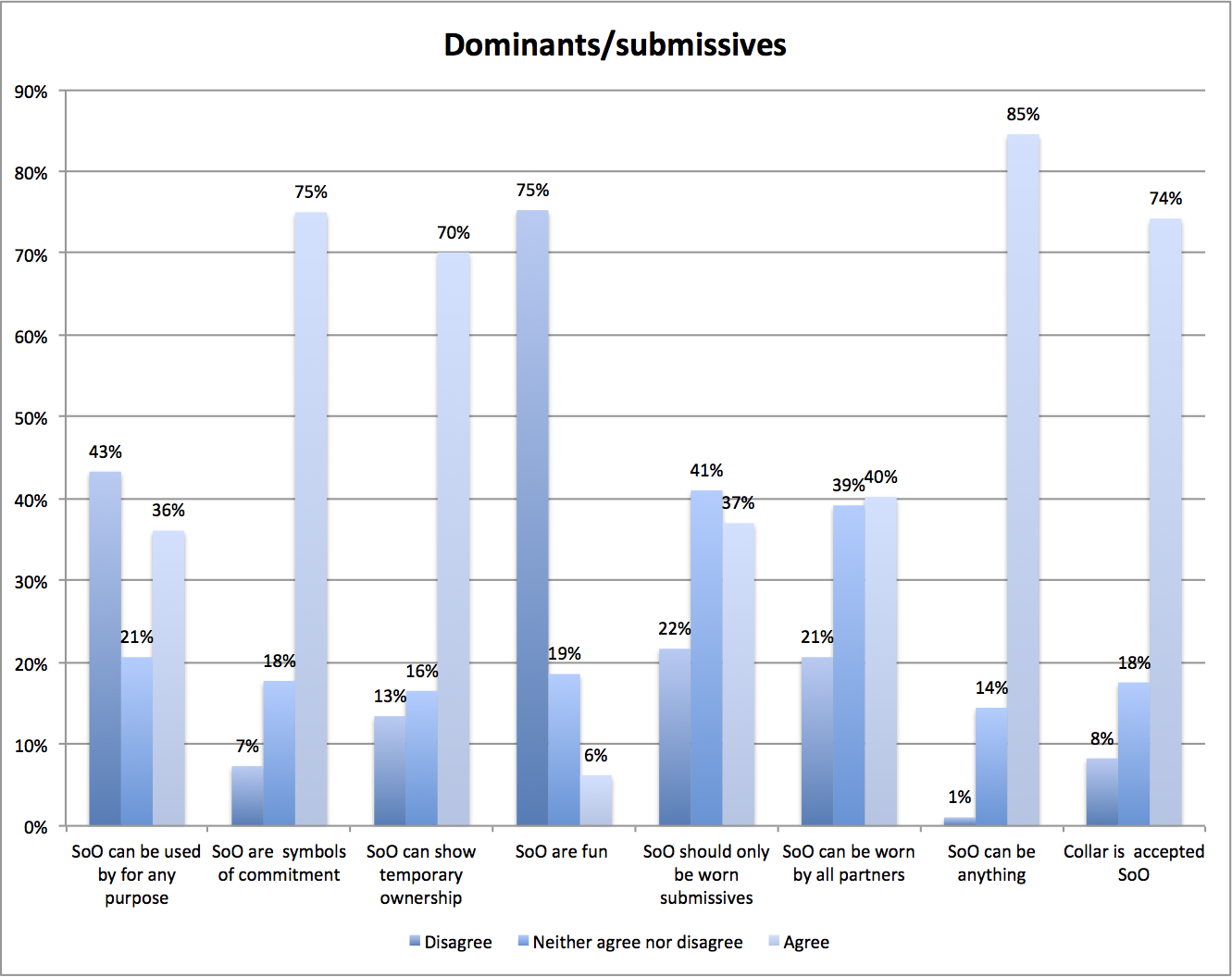
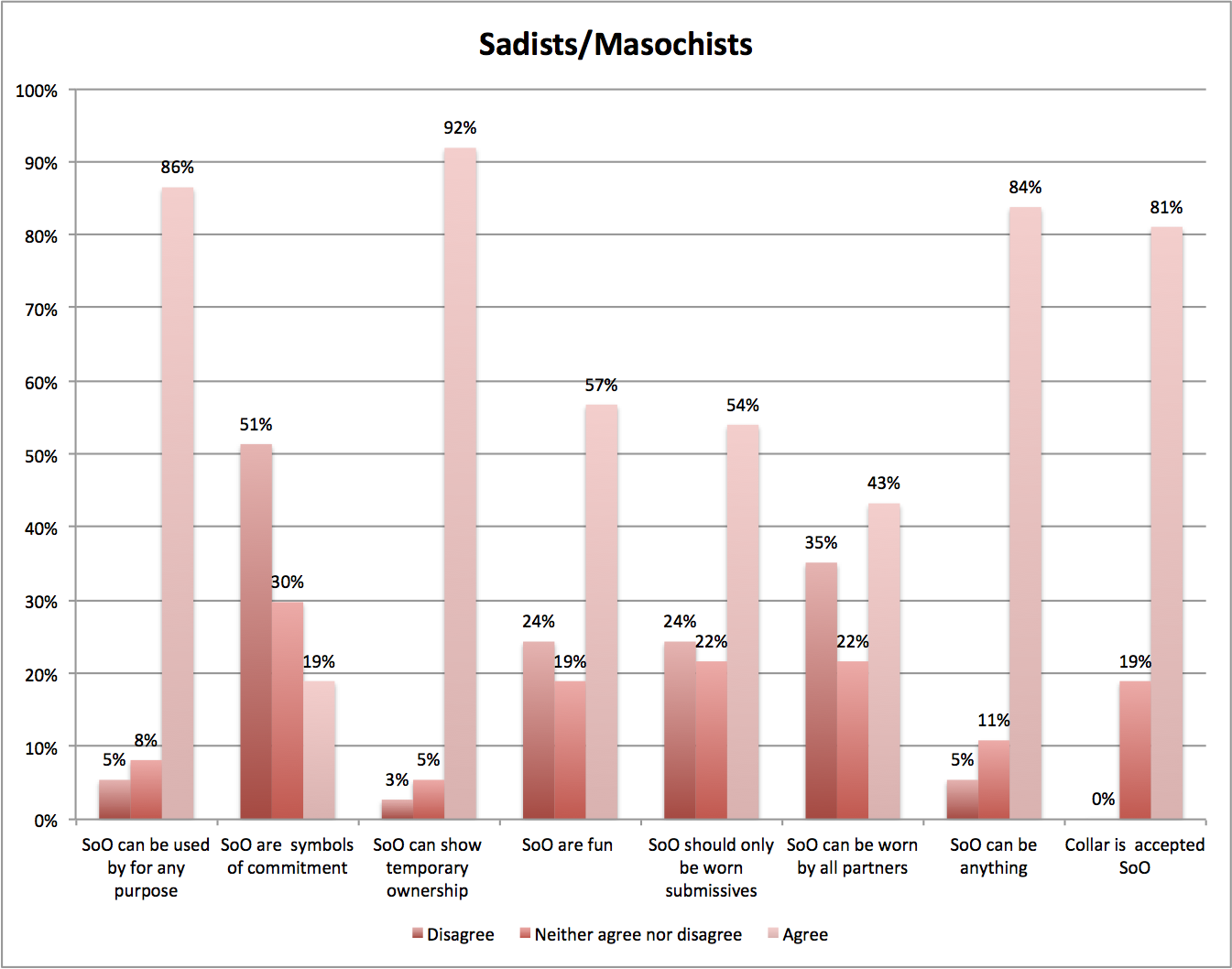
Symbols of ownership can be used by anybody in any BDSM dynamic, for any purpose
72% of M/s people disagreed with this (58% strongly). 14% of M/s people agreed. and 14% were neutral.
Symbols of ownership are important symbols of commitment and permanence and should be worn and respected as such.
86% agreed (70% strongly). 7% were neutral and 7% disagreed.
Symbols of ownership can be worn to indicate temporary ownership (for example in play sessions)
35% agreed (just 5% strongly agreed); 30% were neutral and 35% disagreed (which meant they thought it was ok).
Symbols of ownership are fun and have no other special significance
Only 7% agreed (none agreed strongly). 5% were neutral. 89% disagreed (77% strongly)
Symbols of ownership should only be worn by the submissive partner(s)
54% agreed. 40% responded neutrally and 21% disagreed.
Symbols of ownership can be worn by all partners
23% agreed (2% strongly). 23% were neutral and 249% disagreed (35% strongly disagreed)
A symbol of ownership can be anything the partner(s) agree on
84% agreed (the same as D/s respondents, but slightly more agreed strongly, 51% of M/s respondents as against – 44% of D/s people), 12% responded neutrally and 4% disagreed.
A collar is the accepted BDSM symbol of ownership.
86% agreed (63% strongly). . 14% were neutral and none disagreed!
If you found this interesting or useful, please think about doing the BDSM and Money survey, on the impact of BDSM on people’s pockets. Current results will be visible once you have completed the survey
If you found this interesting or useful, please think about doing the BDSM and Money survey, on the impact of BDSM on people’s pockets. Current results will be visible once you have completed the survey
If you found this interesting or useful, please think about doing the BDSM and Money survey, on the impact of BDSM on people’s pockets. Current results will be visible once you have completed the survey
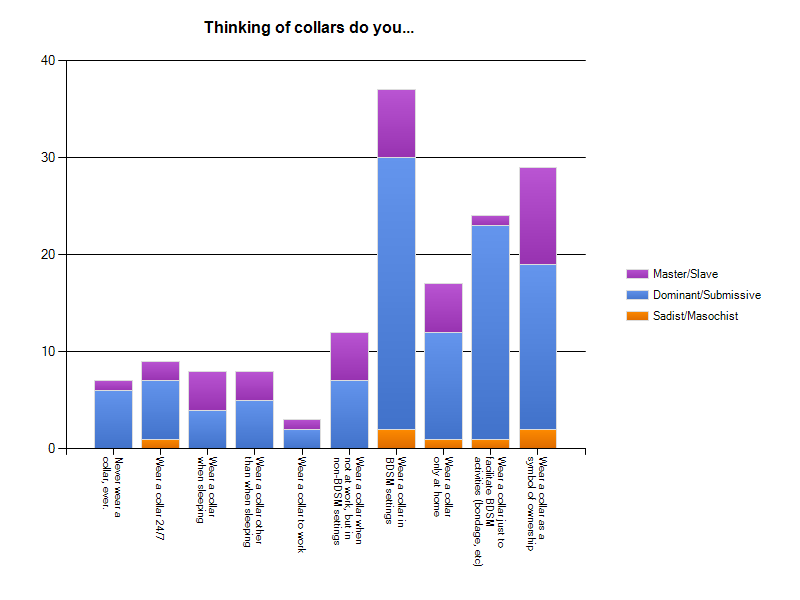
In the survey I did of BDSM symbols and ownership, promoted through my blog and posts on the website Informed Consent, I asked about people’s collar-wearing habits.
Who answered
68 submissive respondents answered this question. Four were masochists, 49 said they were submissives and 15 identified as slaves. 17 people skipped the question. People could choose more than one response.
Collar wearing
Half of the masochists (two people) said they wore a collar as a symbol of ownership. 35% of submissives and 67% of slaves said they wore a collar as a symbol of ownership. None of the masochist respondents said they “Never wear a collar, ever” whilst 12% of submissives and seven per cent of slaves said they never wear a collar.
Clicking on this image opens a larger one which may be more easily readable.
24/7?
25% of masochists (Okay – one person) said they wear a collar all the time, compared to 12% and 13%, respectively, of submissives and slaves. This contrasts with those who wear a collar just for BDSM purposes – 25% of masochists, 45% of submissives and 7% (that’s just one person) of slaves do this.
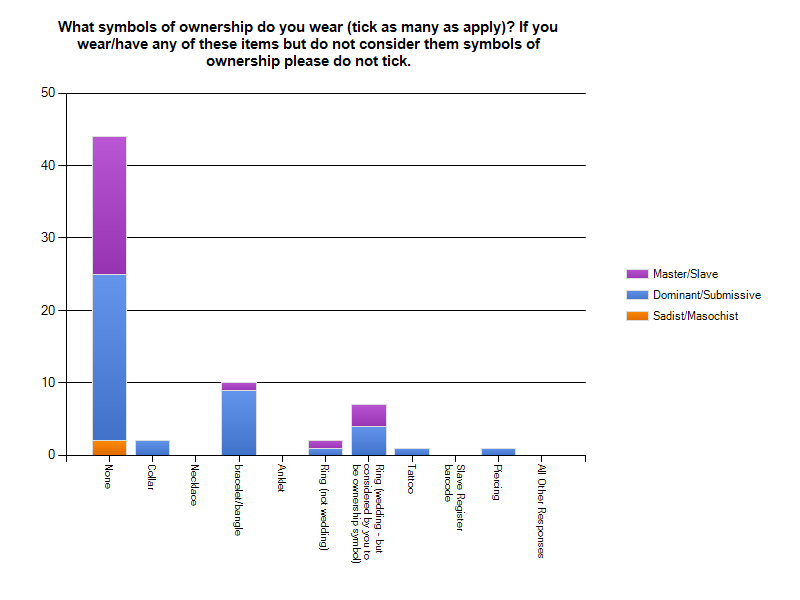
I’ve published that list before on Informed Consent. The charts below are new. They show what respondents said they wore as symbols of ownership. It was possible to choose more than one item, so percentages don’t add up to 100!
Dominants and symbols of ownership
The chart below shows what dominant respondents said they wore (not what their partners wore) as symbols of ownership, it looks at dominants of all BDSM components.
Overall. 73% of all dominants said they wore no symbols of ownership. All S/m dominants said they wore no symbols of ownership (to be fair, that was just two individuals). 66% of D/s dominants said they wore nothing (23 respondents). 86% of M/s Dominants wear no symbol of ownership (19 people).
The most common symbol of ownership worn by dominant respondents was a bracelet or bangle (17% said they wore this), followed by a wedding ring (12%).
Submissives – what do they wear?
74 submissives answered this question. As a symbol of ownership, the collar came top. 68% of all the submissives that answered this question said they wore a collar. 80% of S/m submissive respondents wear a collar to show ownership (4 people). 60% (31 respondents) of D/s submissives said they wear a collar and 88% (15 answerers) of M/s submissives also said they wear a collar to signify ownership.
26% of submissives wear no symbols of ownership.
24% of all respondents say they wear a bracelet/bangle – the second most common symbol of ownership. 25% of D/s respondents and 30% of M/s respondents wear this (no M/s respondents).
The third most common symbol of ownership worn by submissives is the tattoo, worn by 22% overall and 21% of D/s submissive respondents and 29% of M/s submissives who answered. Necklaces were fourth, but not far behind, being worn by 20% of submissive respondents.
Amongst submissive respondents rings (not wedding), at 11% were more common as ownership symbols than wedding rings (7%).
This, my first article on this blog, relates to a survey I did of “Informed Consent” users looking at the symbols, like collars, that they use to display their relationship status and to get an idea of how they regard theses symbols.
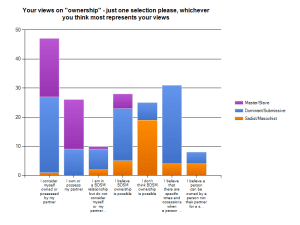
Your views on “ownership” – just one selection please, whichever you think most represents your views
Across the entire sample (broken down by principle BDSM orientation) answers were as follows:
Your views on “ownership” – just one selection please, whichever you think most represents your views
Answer Options
Sadist Masochist
Dominant Submissive
Master Slave
Response Percent
I consider myself owned or possessed by my partner
1
26
20
27%
I own or possess my partner
0
9
17
15%
I am in a BDSM relationship but do not consider myself or my partner to be owned.
2
7
1
6%
I believe BDSM ownership is possible
5
18
5
16%
I don’t think BDSM ownership is possible
19
6
0
14%
I believe that there are specific times and occasions when a person in a BDSM dynamic can be owned by their partner
4
27
0
18%
I believe a person can be owned by a person not their partner for a specific time or activity
4
4
0
5%
Answered question
175
Skipped question
29
This data also appears in the column chart below. What stood out for me was the large proportion of people who characterise themselves as either Dominant/submissive (D/s) or Master/slave (M/s) who are in a relationship they characterise as ownership or possession, or who think this is possible. compared to the high proportion of Sadists/masochists (S/m) who don’t think BDSM ownership is possible.

 Back in October I designed a poll on safewords and more than eighty people then on Informed Consent did a pilot version. I’ve taken their comments into account and have now published it on survey monkey, here.





 A dominant and submissive life