
Differing dynamics: S/m, M/s and D/s

BelasariusThe data below comes from the BDSM Safewords survey but isn’t about safewords – instead it looks at the shape of dynamics of people in different types of BDSM relationships – Sadists/masochists (S/m), Masters( mistresses/slaves (M/s) and Dominants/submissives (D/s).

I asked people about their attitudes to various things BDSM people like to do. The chart below shows broad differences in approach to BDSM people in each of the above groups. What I did was take the score for “essential to me” (see Background, below) and subtract from it the score for “I don’t do this”.

Here is how the top nine areas of interest/interaction differed for each group;

Dominant/ submissive Master/ Slave Sadist/ Masochist
1 Control Control Pain
2 Sex Sex Bondage
3 Bondage Service Sex
4 Exhibitionism Ritual Control
5 Ritual Pain Fetish
6 Service Bondage Exhibitionism
7 Pain Fetish Humiliation
8 Fetish Humiliation Service
9 Humiliation Exhibitionism Ritual

I’ve colour coded the responses. Red represents what I consider the more “physical” aspects of BDSM and blue the more “mental” aspects: I recognise that, like almost everything we do, this is open to wide interpretation – it’s just to try to show some “at a glance” differences more easily. I coloured sex green because I think it’s a sort of relationship fundamental that doesn’t fit easily into either group.

What’s clear is probably not rocket science: The S/m people who responded are more into physical aspects of BDSM than other groups, whilst M/s people prefer “blue” choices and D/s people fall somewhere between.

The chart below looks at this data again, this time ranking it from the most popular to the least popular choices made by D/s people (the biggest group).

D:s, M:s and S:m - how dynamics differ

This chart bases the rankings on the scores for people in each group who said each area was essential to them and then subtracts the scores for those who said they  didn’t do it. So we can see that, for example, not only do service and ritual come well down on sadists/masochists lists of priorities, but they actively dislike them. Control is important for both M/s and D/s people but is, by a long chalk the key characteristic (with service No. 2 – but a fair way back) for M/s people.

Background

The 532 people who responded included 98 S/m people , 89 M/s people and 345 D/s people.

The question asked them to look at each of these things:

  • Pain
  • Bondage
  • Humiliation
  • Exhibitionism
  • Fetish
  • Sex
  • Ritual
  • Service
  • Control

And then asked them to rank each of these as follows:

  • Essential to me
  • Important to me
  • Neither important or unimportant
  • I dislike this
  • I don’t do this

To make the data in this article as stark as possible I only used the “Essential to me” and “I don’t do this” scores.

Results from BDSM styles and relationships survey.

The following, from a post on Informed Consent relating to my BDSM styles and relationships survey, relates to the above. At the time,  331 people had taken part. This is some of what the  104 people who identified as either sadist/masochist or master/slave said about their BDSM styles and relationships.

There’s an interesting demographic difference ( bear in mind these are small samples): 49% of S/m types are in full time work compared with 60% of M/s types. 33% of S/m people are not in work or full time education, whilst this is true of 18% of M/s people.

When it comes to sexuality, 61% of S/mers identified as heterosexual. 73% of M/s people did.

38% of S/m people said they switch. 7% of M/sers do.

Now, Sex. 36% of S/mers said this was essential to them. 64% of M/sers agree.

Next, Pain: 55% of S/mers say it is essential. 23% of M/sers agree. 33% of M/sers say pain is neither important or unimportant.

54% of M/s types say their BDSM relationship is their only one. 33% of S/mers say this. 33% of S/mers are not in a relationship compared with 16% of M/s respondents.

BDSM Safeword Survey: what people said about safeword use.

BelasariusIn the safeword survey I recently completed I asked people to comment on their use of safewords with relationship and play partners. 532 people answered the question There were 118 comments.This article quotes all those additional comments, splitting them by whether they related to play or relationship partners and by gender and BDSM orientation.

This earlier article on the use of safewords with relationship partners add this, on the use of safewords with play partners, may be useful to read alongside this.

Use of safewords with relationship partners

59 people left additional comments on this question.

Women

Bottoms/submissives

Who:

“Always use a safeword”:

  • But have never had to use it.
  • I always have a safeword but do not often use my safeword, in fact, in 14 years, i have used it twice.
  • I always have a safeword there if needed, but rarely use it.
  • I have a safeword but have never used it
  • I have a safeword to use, I don’t necessarily invoke it
  • I have a safeword, but have never had to use it
  • i have one, only used it once in 5 years. It does not end the scene, just lets Sir know something is amiss.
  • We have a safe word but it has never been used.
  • We have agreed safewords, though they are rarely used
  • When it’s a principal partner, the safeword is just an unspoken thing once negotiated in first woo-ing stage. It might not get used for years, but if it ever was used, it would be  honoured.

(10 comments)

“mostly use a safeword:

  • Partner knows when to stop as knows my body very well
  • Sometimes if my partners prefers for ‘no’ to mean ‘no’ then I play that way instead.

(2 comments)

“Never use a safeword”:

  • He knows me well enough that we haven’t needed one
  • he knows me well, i gave it up on the day he collared me as my gift to him to show my utter trust in him
  • I am submissive so it’s not in my nature to safeword as I want to please; my master protects me
  • I dont use a safeword with my partner
  • i have a safeword i’m just stubborn
  • i have never had to use a safe word their use signify’s to me a lack of awareness between partners
  • I have never yet needed to use a safe word but I would if it came down to it.
  • I have one, but have never used it.
  • I would consider using one if it was important to a roleplay that I was able to ‘resist’
  • I’m not permitted one.
  • I’ve never needed to use a safeword.
  • not necessary, partner v responsible, can read me well and will stop before I need him to
  • when I was in a committed relationship the level of trust meant I didn’t need one

(12 comments)

“I mostly DON’T use a safeword”

  • Do you mean during play, or do I have one? I have a safeword, I just rarely <need to> use it
  • he knows me well enough for me not to need one    but it is still availiable should i want to use it
  • I don’t use a safeword with my principal play partner (hard to define whether this is a “relationship”
  • I have a safe word, I have never used it, nor do I expect to.
  • I have a safeword, but try not to use it.
  • I have one but have only used it once (when nipple clamp broke and embedded into me), don’t play with someon unless i know they can read me
  • I have one but have very rarely felt need to use it.
  • I use “no” and “stop” if safewords aren’t applicable
  • I usually default to the standard “red light” etc, but almost never need it.

(9 comments)

Switches

“Always use a safeword”:

(0 comments)

“mostly use a safeword:

  • I always HAVE a safeword but I have NEVER had to use it yet. Can’t select this from options

(1 comment)

“Never use a safeword”:

  • I don’t have one, but on the very rare occasion when something has been ‘wrong’ my partner has read my response and recognised the need to respond appropriately
  • we have a safeword but i have never had to use it

(2 comments)

“I mostly DON’T use a safeword”:

  • We have one established, but it’s never had a need to be used.

(1 comments)

Tops/dominants

“Always use a safeword”:

  • I require a sub to have a safeword but have never really had it invoked.
  • Our safeword is No, unless we discuss otherwise and use the traffic light system.

(2 comments)

“mostly use a safeword:

(0 comment)

“Never use a safeword”:

(0 comments)

“I mostly DON’T use a safeword”:

(0 comments)

Men

Bottoms/submissives

“Always use a safeword”:

  • Haven’t actually used it but it is always available

(1 comments)

“Mostly use a safeword:

  • the need for one rarely arrises, but agree one just in case

(1 comment)

“Never use a safeword”:

  • No partner

(1 comments)

“I mostly DON’T use a safeword”:

  • Not needed with established relationships

(1 comments)

Switches

“Always use a safeword”:

  • It’s there but I’ve never needed it. Please feel free to recode this if you feel that isn’t using a safeword.
  • When I say I always uss a safeword, I mean that my partner and I have a safeword agreed, and so it’s always there. Doesn’t mean we actually feel that we need one for every scene.

(2 comments)

“mostly use a safeword:

(0 comment)

“Never use a safeword”:

  • I always have a safeword I hate hearing it. I try to develop a very intimate connection and know rather than hear when things are getting too much for them.
  • I don’t have a partner
  • I have never needed to, as I have (apart from one exceptional case) been in a position where “no” or “stop” didn’t mean what they say.
  • n/a no in a relationship
  • Never get to safeword level
  • never play with the gf

(6 comments)

“I mostly DON’T use a safeword”:

  • I prefer to discuss things beforehand to reduce the need of a safeword.

(1 comment)

Tops Dominants

“Always use a safeword”:

  • ..But only one, which stops all play, possibly indefinitely.  I don’t use stop/go/traffic light safewords.
  • actually, she does
  • some partners dont

(3 comments)

“mostly use a safeword:

  • my current sub does not safeword though I give her the option

(1 comment)

“Never use a safeword”:

  • I have suggested it might be a good idea but all the subs I have played with disliked the idea

(1 comment)

“I mostly DON’T use a safeword”:

(0 comments)

Use of safewords with play partners

59 people left additional comments on this question.

Women

Bottoms/submissives

Who:

“Always use a safeword”:

  • but only play with my Sir.
  • I always have a safeword to.use doesn’t  mean I use it.
  • I have a safeword but rarely use it
  • I have a safeword to use, I don’t necessarily invoke it
  • I have never had to use it
  • I’m interpreting this q as: I always negotiate the possibility of a safeword with people I do BDSM play with, even though I’ve never yet felt the need to employ it.
  • If I did play outside of my principle relationship – safeowrd would be mandatory
  • Master puts me with others  and  safeword  is always in place

(8 comments)

“mostly use a safeword:

  • I have a safe word, I have rarely used it. I do not expect to have to use it.
  • I sometimes forget to use the safeword it the situation overwhelmes me to the point of tears.

(2 comments)

“Never use a safeword”:

  • Again, never needed to use one but would if necessary.
  • Being used by others is part of what he wants for me. He controls it.
  • don’t have play partners
  • I never ‘play’ I only have relationships.
  • I only play with my sir
  • I only play with my partner
  • My master always supervises things when he gets other people to play with me.
  • My master decides when to stop play
  • My master supervises any play I take part in
  • My partner decides when things stop
  • My partner supervises my use. He decides when things should stop
  • When I am required to play with others I trust my partner to ensure I am not harmed more than he wants.

(12 comments)

“I mostly DON’T use a safeword”:

  • Depends if I know them well enough not to use a safe word, most of my friends know me well enough to not need a safe word. I rarely play with others.
  • He is always there to supervise
  • I don’t use safewords because the people i play with i know very well and they know me, i trust them entirely.
  • I have given a safeword to a play partner but found it ineffective – he would never have used it.  I stopped play when I felt he was marking badly.
  • I only use a safe word when in a new relationship, but expect partners to know and respect my limits.
  • I safeworded once but from pleasure not pain
  • I use “no” and “stop” if safewords aren’t applicable
  • It’s very rare.
  • My partner decides whether I should use a safeword when being played with by someone he chooses
  • same question: I always HAVE a safeword, however, the one time we played with others I found it hard to use…and I should have

(10 comments)

Switches

“Always use a safeword”:

  • I have a safeword, but I’ve not yet needed to use it

(1 comment)

“mostly use a safeword:

  • Only use a safeword if I am bottom/submissive, don’t bother if I top/domme as I don’t do any extreme play as a top.
  • I always HAVE a safeword but I have NEVER had to use it yet. Can’t select this from options
  • When topping, I always insist my bottom has a safeword.  When bottoming, I always have one with new partners.  When I have an ongoing play dynamic with someone, I’m more relaxed about it as I know I keep the ability to communicate well

(3 comments)

“Never use a safeword”:

  • (0 comments)

“I mostly DON’T use a safeword”:

  • almost never
  • With my current play partner. I have done before and may again with (an)other(s)

(2 comments)

Tops/dominants

“Always use a safeword”:

  • I play that no doesn’t mean no. Instead, I employ the traffic light system – green ok, amber check in, red stop.

(1 comment)

“mostly use a safeword:

  • I only play with those in a relationship

(1 comment)

“Never use a safeword”:

  • I know I’m not a nutter, so don’t feel the need.

(1 comment)

“I mostly DON’T use a safeword”:

(0 comments)

Men

Bottoms/submissives

“Always use a safeword”:

(0 comments)

“mostly use a safeword:

  • Usually Green, Amber, Red when playing in public with new friends.

(1 comment)

“Never use a safeword”:

  • Usually Green, Amber, Red when playing in public with new friends.

(1 comment)

“I mostly DON’T use a safeword”:

(0 comments)

Switches

“Always use a safeword”:

(0 comments)

“mostly use a safeword:

  • always a safe word with someone new

(1 comment)

“Never use a safeword”:

  • I have (apart from one exceptional case) been in a position where “no” or “stop” didn’t mean what they say.

(1 comments)

“I mostly DON’T use a safeword”:

  • Most of my “play” wth other people has been at Peer Rope events; that play doesn’t require a safeword as such.

(1 comment)

Tops Dominants

“Always use a safeword”:

  • A safeword is essential for clear FAST communication.
  • again, she does
  • I listen to their comments.

(3 comments)

“mostly use a safeword:

(0 comment)

“Never use a safeword”:

  • Dont play with others outside of my relationship
  • I only have one partner
  • no play partners outside principal relationship

(3 comments)

“I mostly DON’T use a safeword”:

  • have it dont need it
  • I’m the top!  I have not had a girl use a safeword during play, and only twice to terminate play forever – once before the first meet!

(2 comments)

Background

This is the third article about the safeword survey I recently conducted. More information about the terms and ideas I use in these surveys can be found here. Information about the demographics of this survey is here.


The Gender Gap

BelasariusIn my safe word survey I asked people about their attitudes to various things BDSM people like to do. This article isn’t about safe words, it’s about the different dynamics men, women, tops/dominants, switches and bottoms/submissives have. or, at least, it is about the results reported by the people who responded to the survey.

The first chart, “the gender gap“, shows broad differences in approach to BDSM by men and women. What I did was take the score for “essential to me” (see Background, below) and subtract from it the score for “I don’t do this”.

The 524 men and women who responded to this were, clearly, different. For example, women (surprisingly – at least to me) were much more likely to characterise sex as “essential” than were men.

The_Gender_GapMen are slightly more into the physical elements of BDSM (Pain, Bondage), whilst women revel in control, service and ritual to a far greater extent than men. In fact the men who responded actively dislike ritual – something a few women find essential to their dynamic.

Women had negative scores for both humiliation and exhibitionism – some men find humiliation essential.

I found it interesting that more men than women said they found fetish essential. I associate fetish with dressing up and thought that more a female thing. I may enquire more.

How orientations shape dynamics.

The next two charts are specific to gender and show differences in approach to BDSM according to whether the respondents were tops/dominants, switches or bottoms/submissives.

Component_Fem

It can be seen that, in many respects, males and females in the same orientation group have a similar outlook on BDSM. There are differences of course. Male tops/dominants have more interest in physical BDSM than do women – and female submissives and switches are much more interested in sex than dommes. Male tops/dominants are more interested in sex than their female  counterparts.

Component_Male

Control is interesting too: Switches of both sexes and male bottoms/submissives have a moderate interest in control, whilst For female bottoms/submissives, and tops/dominants of both genders it is the characteristic seen as most essential out of them all.

Background

In this case the charts are based on data from 524 people.

The question asked them to look at each of these things:

  • Pain
  • Bondage
  • Humiliation
  • Exhibitionism
  • Fetish
  • Sex
  • Ritual
  • Service
  • Control

And then asked them to rank each of these as follows:

  • Essential to me
  • Important to me
  • Neither important or unimportant
  • I dislike this
  • I don’t do this

To make the data in this article as stark as possible I only used the “Essential to me” and “I don’t do this” scores.

BDSM safeword survey – does age alter behaviour?

This article looks at how people who answered the safeword survey said they used safewords and whether this differed for older or younger respondents.

It does. There are large variations according to age and also dependant on whether the BDSM interaction is with a relationship partner or a play partner.

The survey, of course, isn’t representative of anything except the views of people who took part. It’s important to note that some of the age groups are quite small. There were only eight people aged 18-20 (all were women) and four over 70 (all men). The other groups ranged in size from 77 to 148 so are more likely to reflect a spread of opinion (496 of the 533 people in the sample answered the question).

safeword use by age

Only 18-20 year olds were more likely to use safewords with both relationship partners and with pay partners.

Over all the age groups, when it came to relationship partners, every group except the 18-20s said they were more likely not to use safewords (other than people of 70 or older where the decision was split 50-50).

When it comes to BDSM interactions with play partners, five of the seven age groups said they were more likely to use safe words than not. The two age-groups that said they were less likely to use safewords (21-29 and 30-39 year olds) only did so by a margin of two or three per cent.

Data for this article

The data for this article was compiled from that contained in the table below.

Thinking of BDSM interactions with your principal relationship partner(s) and safewords…
Which category below includes your age? I always use a safeword I mostly use a safeword I mostly DON’T use a safeword I never use a safeword Grand Total
Female 18-20 6 1 1 8
21-29 10 7 6 27 50
30-39 22 5 20 46 93
40-49 21 10 19 46 96
50-59 9 4 7 19 39
60-69 2 1 2 2 7
Female Total 70 28 54 141 293
Male 21-29 8 2 2 10 22
30-39 12 8 12 15 47
40-49 12 9 4 30 55
50-59 13 6 11 23 53
60-69 8 3 3 4 18
70 or older 1 1 1 1 4
Male Total 54 29 33 83 199
Grand Total 124 57 87 224 492
Thinking of BDSM interactions with play partners and safewords…
Which category below includes your age? I always use a safeword I mostly use a safeword I mostly DON’T use a safeword I never use a safeword Grand Total
Female 18-20 6 2 8
21-29 15 5 14 16 50
30-39 28 14 25 26 93
40-49 36 13 19 28 96
50-59 13 6 9 11 39
60-69 2 2 1 2 7
Female Total 100 40 70 83 293
Male 21-29 9 7 3 3 22
30-39 14 13 13 7 47
40-49 15 12 11 17 55
50-59 18 7 14 14 53
60-69 10 3 3 2 18
70 or older 2 1 1 4
Male Total 68 43 45 43 199
Grand Total 168 83 115 126 492

Background

This is the third article about the safeword survey I recently conducted. More information about the terms and ideas I use in these surveys can be found here. Information about the demographics of this survey is here.

This article can be compared with an earlier one, looking at how people use safewords with their principal relationship partners.

Related articles

BDSM Safeword Survey – who uses safewords with play partners

BelasariusThe safeword survey survey asked the question “Thinking of BDSM interactions with your play partner(s) and of safewords…” and then asked how likely the respondent was to use a safeword.

500 of the 533 people in the sample answered the question.

This article looks at the use of safewords with play partners and looks at the differences that characterised respondents to the survey, based on their BDSM orientation.

Switches use safewords more.

Safeword Survey play partners switch top dominant bottom submissive

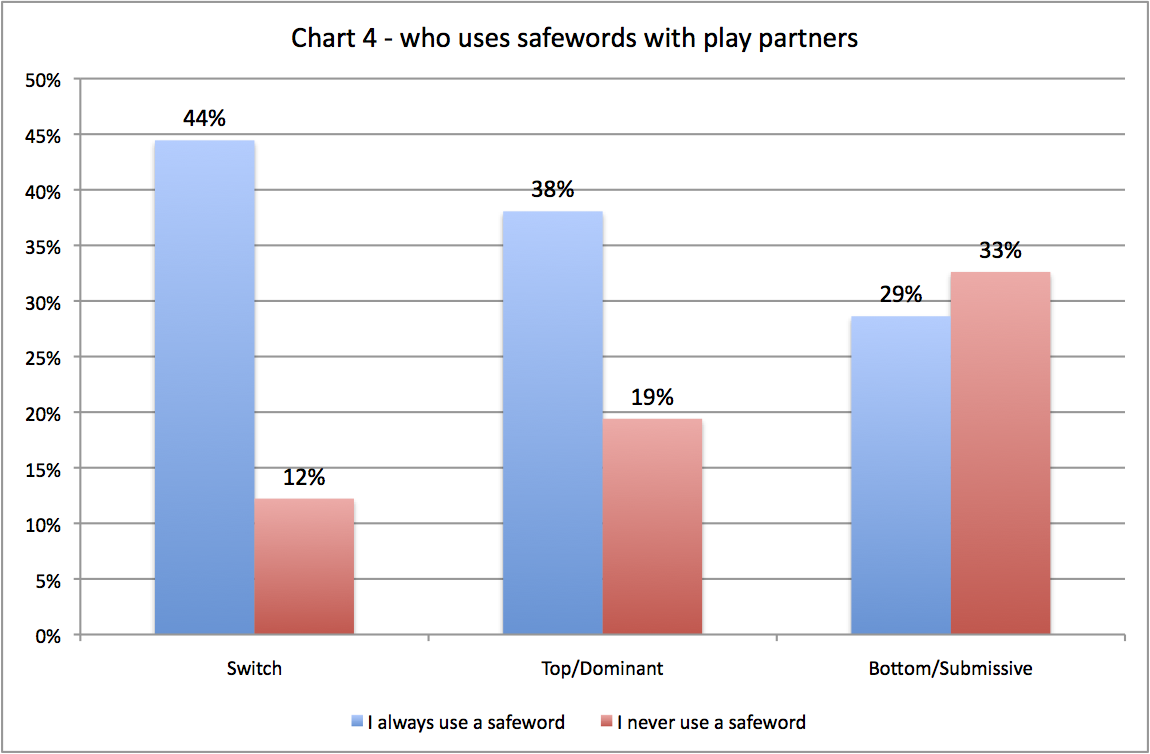
I looked just at those people who always use safewords or never use safewords, crosstabbed with their BDSM orientation (Chart 4). Both switches and Tops/dominants said they were more likely to always use a safeword with play partners than to never use a safeword. By contrast, bottoms/submissives stated they were more likely to never use a safeword.

This contrasts with the way people use safewords with their principal relationship partners, where far fewer said they used safewords.

Safewords – and numbers of play partners

I asked respondents how many people they played with in a year. I thought it might be interesting to look at whether the number of play partners people said they had affected the way they used safewords.

Bottoms/submissives

bottom submissive play partner safeword use

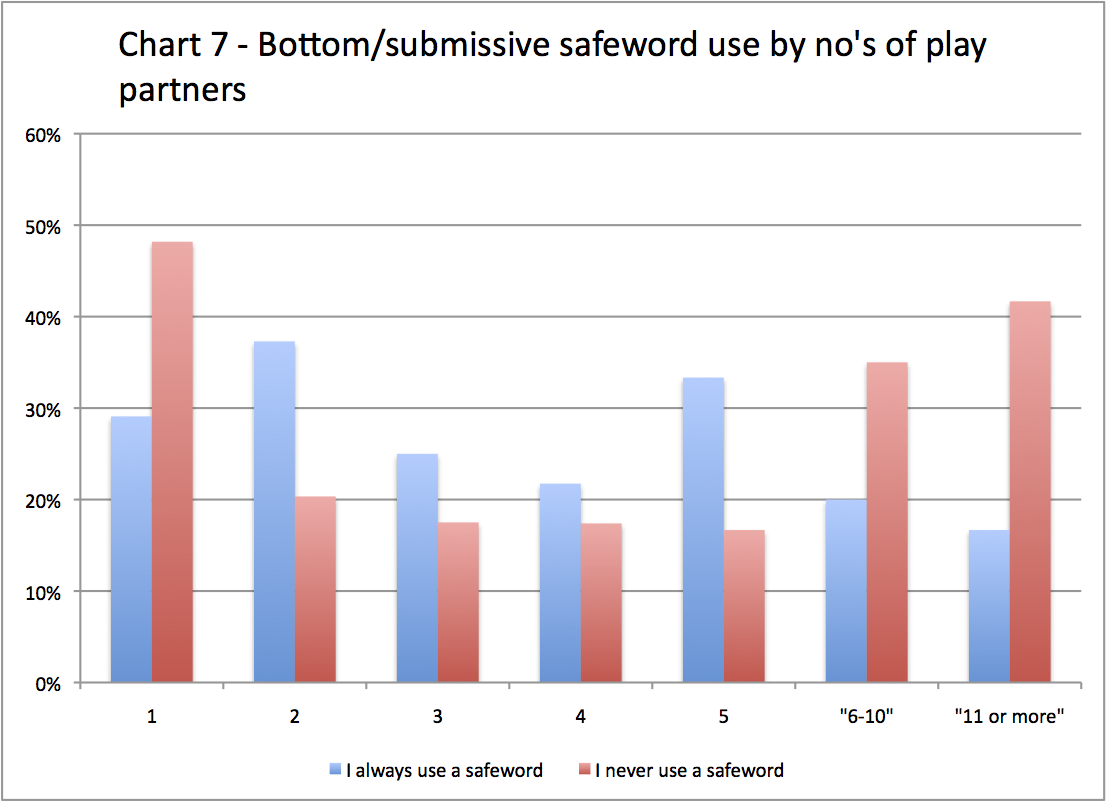
Bottoms/submissives who said they only played with one person in the last 12 months are much more likely to never use a safeword than they are to use one all the time. But bottoms and submissives with low or moderate numbers of play parters (between two and five) said they are more likely to use a safeword all the time than not to use one at all.By contrast those who said played with larger numbers of people may be more devil-may-care and are much more likely to never use a safeword than always to use one.

Switches

Switch safeword use


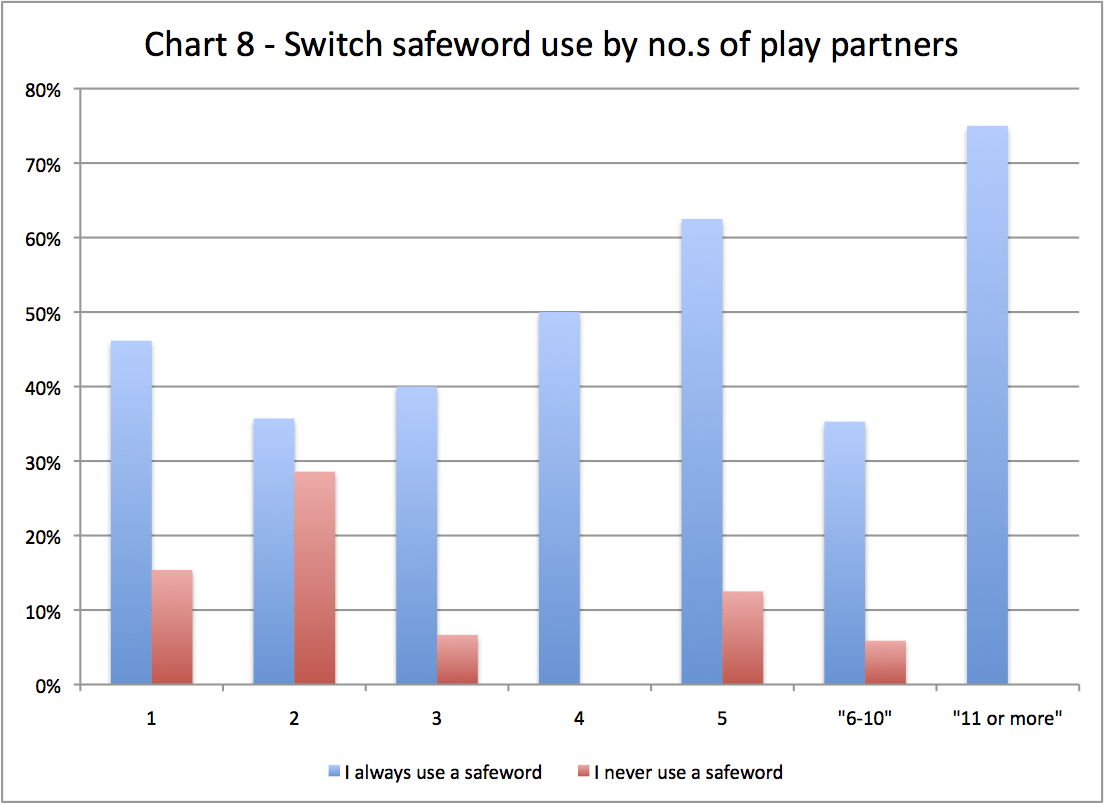
Switches contrasted sharply with both bottoms/submissives and tops/dominants. Throughout the sample switch respondents stated they were more likely to always use a safeword than to never use a safeword. And, with a couple of exceptions, the more play partners a respondent had, the more likely this was to be what they said.

Tops/Dominants

Top and dominant use of safewords

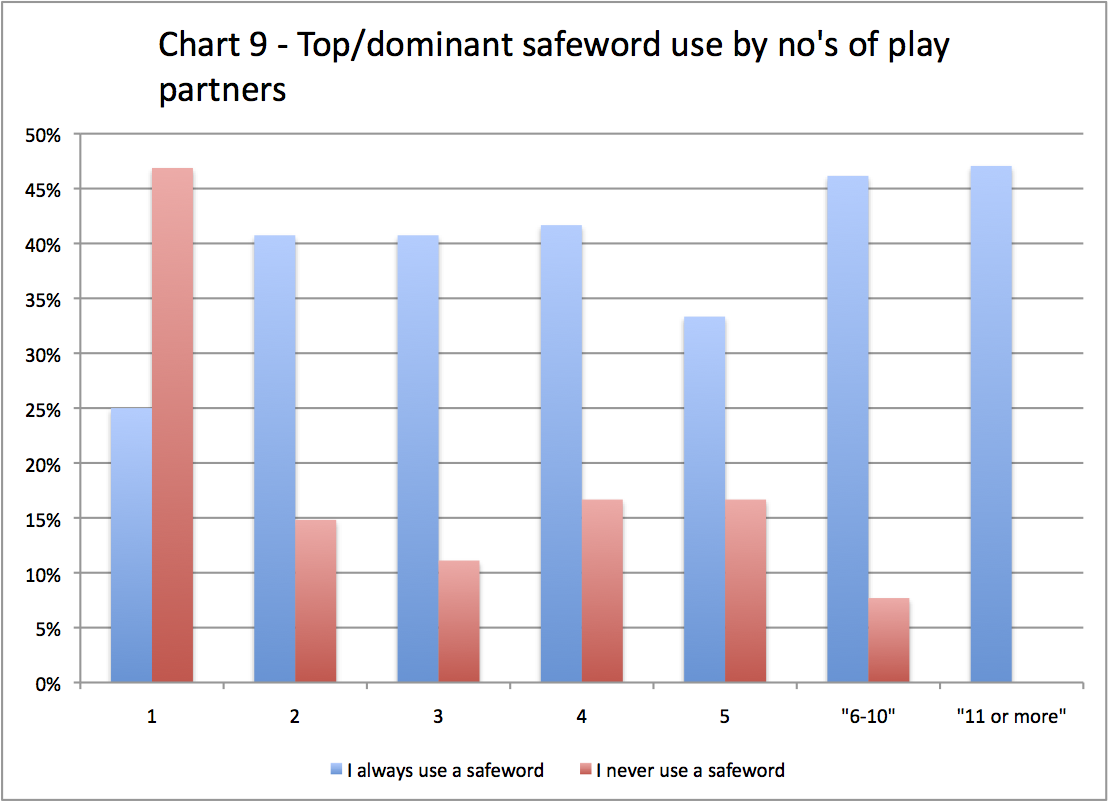
Tops/dominants with a single plat partner said they were much more likely never to use a safeword than to always use one. But for every other no. of partners the reverse was true. Though the proportion always using a safeword was very much higher than the proportion that never use a safeword, for every number of partners other than one, the levels of safeword use reported were fairly level in comparison with switches – where it respondents reported that the more partners they had the more likely they were to use a safeword all the time.

Data for this article.

The table below shows the numbers of respondents from which the charts above were compiled. Some of the groups are very small.

Thinking of BDSM interactions with play partners and safewords…
No of play partners I always use a safeword I mostly DON’T use a safeword I mostly use a safeword I never use a safeword All
Bottom/Submissive 1 32 18 7 53 110
2 22 18 7 12 59
3 10 14 9 7 40
4 5 7 7 4 23
5 4 2 4 2 12
“5-10” 4 6 3 7 20
“10 or more” 2 2 3 5 12
Bottom/Submissive Total 79 67 40 90 276
Switch 1 12 6 4 4 26
2 5 3 2 4 14
3 6 4 4 1 15
4 3 1 2 6
5 5 2 1 8
“5-10” 6 2 8 1 17
“10 or more” 3 1 4
Switch Total 40 17 22 11 90
Top/Dominant 1 8 6 3 15 32
2 11 8 4 4 27
3 11 8 5 3 27
4 5 1 4 2 12
5 2 2 1 1 6
“5-10” 6 4 2 1 13
“10 or more” 8 6 3 17
Top/Dominant Total 51 35 22 26 134
Total 170 119 84 127 500

Background

This is the third article about the safeword survey I recently conducted. More information about the terms and ideas I use in these surveys can be found here. Information about the demographics of this survey is here.

This article can be compared with an earlier one, looking at how people use safewords with their principal relationship partners.

What do sadists really like (and submissives, and slaves, etc).

BelasariusBack in June 2012 I ran a survey on BDSM styles and relationships (or “BDSM – How Do You Like Yours”) which looked at some of the basic components of BDSM interactions.

This article looks at the question “How do various BDSM components fit into your life”. It shows, probably unsurprisingly, that respondents that characterised themselves as sadists/masochists (S/m)ranked things quite differently from dominants/submissives (D/s) and masters (mistresses)/slaves (M/s)

S/m people said pain was better than sex. For M/s respondents control, service and ritual came before a roll in the hay. D/s people put sex first, but only a tiny, tiny bit ahead of control.

More details are found in the charts below – where the top three interactions  for each group appear in darker colours and the bottom two in lighter shades.

Background

Respondents were asked to score each area 1- 5 in a range of responses that were:

  1. I don’t do this
  2. I dislike this
  3. This is neither important nor unimportant
  4. This is important to me
  5. This is essential to me

The ten areas of interaction were:

  • Pain
  • Bondage
  • Fetish dressing
  • Humiliation
  • Exhibitionism
  • Sex
  • Safewords
  • Service
  • Ritual
  • Control

429 people answered the question: 94 said they were sadists/masochists, 277 said they were dominants/submissives and 58 said they were masters/slaves. 31 people skipped the question.

Sadists & Masochists

S&M interactions

Those who responded saying they were sadists and masochists put pain  a long way ahead of everything else as the thing that was most important to them. Bondage just edged sex into third place. Control, in fourth, was fairly important too. Service and ritual came ninth and tenth.

Masters (mistresses) and slaves.

M & s interactions

Control is the biggest thing for respondents in this group, with service coming second and ritual and sex a short way behind, in joint third. The least important factors are fetish dressing and safewords, which trails a long way behind the other factors. Bondage was a little more important than pain to M/s people.

Dominants and submissives

D&S interactions

Dominants and submissives were the only group who put sex at the top of their list. And then, it is only a teensy way in front of control, with bondage a little way behind. Pain comes fourth. The two areas that least interest the D/s people who took part are humiliation and, last of all, exhibitionism.


BDSM People who like “pain” and safewords

BelasariusOne of the things I usually ask in my surveys is for people to say how interested they are in aspects of BDSM interactions – things like “pain“, “control”, “service”, “bondage”, “exhibitionism“, etc.

In the context of safe words I thought it would be interesting to see how people who enjoy pain one of the intrinsically riskier BDSM practices – use safe words.

Looking at the sample as a whole (500 people answered this question) 43% of people who said “pain is essential to me” NEVER use a safeword.  27% always use a safe word. Even among those who say they dislike pain the biggest group (42%) say they never use a safe word (33% say they always do). The only group where the largest response was that they always use a safe word were among those who say they “don’t do pain”, when 57% say they always use a safe word (see table four, below).

Table 4 – Attitude to pain and use of safewords
Pain I always use a safeword I mostly DON’T use a safeword I mostly use a safeword I never use a safeword
Essential to me 27% 19% 10% 43%
I dislike this 33% 18% 6% 42%
I don’t do this 57% 14% 29% 0%
Important to me 22% 17% 13% 48%
Not important/unimportant 26% 19% 9% 46%
All 25% 18% 12% 45%

Things get even clearer if you combine the responses to “I always use a safe word” and “I mostly use a safe word” together and also pair “I never use a safeword” with “I mostly DON’T use a safe word”. This then shows that, when it comes to inflicting or receiving pain, roughly one in three are inclined to use safewords and roughly two thirds are inclined not to. (table 5). The group that said they don’t do pain (admittedly only 1.4% of the sample – just seven people) are quite different: 86% use safe words.

Table 5 – Attitude to pain and use of safewords – Use and don’t combined
Pain Always/mostly use a safeword Never/mostly don’t usa a safeword
Essential to me 38% 62%
I dislike this 39% 61%
I don’t do this 86% 14%
Important to me 36% 64%
Not important/unimportant 35% 65%
All 37% 63%

I also looked at how the picture changes if you split respondents by their BDSM orientations (Bottom/submissive, Top/dominant and Switch) – see charts four and five below. Interestingly the B/s people (72%) and T/d people (82%)  who responded  are more likely to consider pain important or essential than switches (67%). Amongst those who think pain is important the largest groups by far never use safewords or mostly don’t use them. Amongst those who dislike or won’t do pain (a small proportion of the total sample) slightly more say they always use a safeword than those who say they never do.

SfC5

SwC4

BDSM Safe word Survey – who uses them with their principal partners

standing stoneThis is the first article about the safeword survey I recently conducted. More information about the terms and ideas I use in these surveys can be found here. Information about the demographics of this survey is here.

The survey asked the question “Thinking of BDSM interactions with your principal relationship partner(s) and of safewords…” and then asked how likely the respondent was to use a safeword. 500 of the 533 people in the sample answered the question.

Chart 1 - who uses safewords with their partners (by gender)

Chart one (above ) shows the responses to the question and Table one (below) shows the same data as percentages.

Table 1 Thinking of BDSM interactions with your principal relationship partner(s) and safewords…
Any other preference Female Male Grand Total
I always use a safeword 38% 24% 27% 25%
I mostly DON’T use a safeword 25% 18% 17% 18%
I mostly use a safeword 13% 10% 15% 12%
I never use a safeword 25% 48% 42% 45%
Grand Total 100% 100% 100% 100%

So, across the entire sample, all respondents were far more likely NOT to use safewords with their principal partners than to use safewords (the responses on play partners are quite different, as we shall see in forthcoming blogs). sixty-three percent either never use a safeword with their partner (45%) or “mostly DON’t use a safeword” (18%). Only one in four (25%) always used a safeword. This reflects the results of the survey I did here in August 2012, where 61% of the 309 people who took part said they mostly don’t use safewords.

Gender

Women appear slightly less likely to use a safeword than men. 66% of women either did not use a safeword at all or mostly did not. 59% of men answered in these ways.

BDSM Orientation

Things are different when you analyse the sample by orientation (Sadist?masochist – S/m, Dominant/submissive – D/s, and Master/slave – M/s).

Chart 2 - Who uses safewords by BDSM component

Chart 2 (above) and table 2 (below) show the raw numbers and percentages of each group that answered this question in each way.

Table 2 Thinking of BDSM interactions with your principal relationship partner(s) and safewords…
Dominant/ Submissive Master/Slave Sadist/ Masochist All
I always use a safeword 27% 6% 38% 25%
I mostly DON’T use a safeword 18% 8% 27% 18%
I mostly use a safeword 14% 2% 13% 12%
I never use a safeword 41% 84% 22% 45%
Grand Total 100% 100% 100% 100%

S/m respondents were far more likely to use a safeword (38% always did – well ahead of the sample as a whole – 25%). M/s people said they were least likely to use a safeword: Only 6% said they used one all the time and 84% said they never used them. Only 22% of S/m people said they never used a safeword.

D/s respondents (who are most of the participants) lay between these extremes and close to the averages for the sample as a whole.

BDSM Orientation

There always seems to be a bias in these surveys towards submissives, especially females. Perhaps they are just more into surveys!

Chart 3 - who uses safewords - by orientation

Chart Three (above) shows how tops/bottoms and switches use safewords and table 3 (below) gives the same data in percentages. Again, it’s clear that, across all respondents, most either don’t use a safeword at all – or not the majority of the time.

42% of Tops/dominants use safewords all or some of the time compared with 30% of bottoms/submissives. This contrasts with switches where a majority (52%) mostly use safewords.

Switches were also the group most likely to use safewords with their partners all the time – 38% said they did (20% for bottoms and 29% for tops).

Table 3 Who uses safewords by BDSM orientation
Bottom/ Submissive Switch Top/Dominant All
I always use a safeword 20% 38% 29% 25%
I mostly DON’T use a safeword 18% 26% 12% 18%
I mostly use a safeword 10% 13% 13% 12%
I never use a safeword 52% 23% 46% 45%
Grand Total 100% 100% 100% 100%

Curvy_bottom, Informed Consent, and me…

BelasariusThe blog below was first posted on the UK-based BDSM website, informed consent – at the time of writing due to close between 17 and 24 February 2013. It will be much missed by many.

I owe a lot to IC, and this, my 5,000th post there, tried to express a little of what IC had done for me – not the least of which was to help me find my girl

IC helped me change my life.

Informed Consent
Informed Consent (Photo credit: Kevin Krejci)

When I joined IC, I was in the 12th year of a marriage that should not have lasted that long. I was a devoted father and an abused husband.

It seemed it was escapism that brought me here – desire to recapture something healthier, if less conventional, that I’d shared years before. Certainly, at first, I kidded myself I just wanted vicarious satisfaction – to look, but not to live it.

Thinking back, it seems it was actually my very first step toward escaping my marriage, and getting back myself – and my family – and finding someone who cares for me.

There’s a lot I regret about the time since, but I have no regrets about where I find myself now.

I have a lover who is my partner. Is she my submissive? Yes. Is that important? Yes, vital – but not in the way I expected it to be. I have been here before in some ways, many years ago, when I lucked into my second serious relationship – also my first D/s one. That first time, we both wanted everything and, for a time, that’s what we thought we had.

We were both young. Everything was ahead of us then, whereas now, I have as much of a past behind me as there is a future still to come. That past is part of me and I’ve no desire to leave it behind.

For c_b and me, things are different. Both she and I have rich pasts. Neither she nor I are in a position to give the other everything even though it always feels that we do. I have my children – and leaving their home and my marriage saved my relationship with them. Since, it has strengthened immeasurably.

C_b has her marriage and the life she has built with her husband in over 20 years of life together.

We have our relationship: as lovers, as friends, as partners. And we have our dynamic.

I’ve thought more and more about this dynamic and how it makes our relationship possible, and I am afraid I have few answers. I possess her when she is with me and there is a vital part of her (her submission) that is always only mine.

Neither of us considers the other of less than equal worth or inferior in any way. I love her more completely than I have any other and, for a long time, I considered that, in the context of the kind of relationship I needed (a D/s one) ,this made me inferior – because I worried that c_b could live without me much more easily than I could without her.

We each decided – twice – that love was not enough and that our futures could not lie together. But, now – and, I hope, until she buries me, or I her – we are a tough little partnership with a real prospect of continued success.

Of course, all the best love stories are tragedies, so I am not going to promise myself that this will last forever, but I’m sure, right now, that both of us aim to try.

At the moment, I think that if there is a secret to what we have achieved so far, it is in something that could apply to any couple – but which, for me and for her, has been made easier by a D/s dynamic.

We’re hard work. Both of us.

Not to others, I hope, but certainly to each other. Because we concentrate on each other. Because we try to put the other person first. I’d thought this was only possible in a D/s relationship and have often said so here. I now think I was blinkered and that it is possible for anyone – but I think our D/s natures make it possible for c_b and myself.

An example. c_b hardly ever asks for anything or tells me what she likes or wants. It’s something that just happened and it’s something that we’ve only really talked about recently. But, she always accepts my decision or my choice. It reinforces my D mojo because, in a shared relationship, there is much I can’t be responsible for. But, I want c_b to want me and to welcome what I do with or to her. So, I watch hard to see what makes her feel great, whether because she takes a genuine pleasure in pleasing me or if it is just something that makes her feel good. (Rope, anyone?)

This often leaves me puzzled. If all she wants is my pleasure, then what – really – is in it for her? Well – just that. When she thinks she’s pleased me more than she ever has before, when she thinks she’s amazed me, she feels great. And, sometimes, that’s when I wonder who has the whip hand – because she’s grinning and proud because of the way she’s made me feel and all I can be is amazed at what she’s done for me.

But I know she wouldn’t want to be the best she can be for me if she did not genuinely feel she could offer me her submission. It hasn’t happened just because I am dominant and she is submissive and we get on with each other. It did not happen because we fell in love. It happened because I gained her respect and she desired to give me authority to look after her and to use her. And, I know that if either of us lose that respect for the other, it’s over.

She is in all of my life – not a D/s compartment. c_b knows my children and the rest of my family, my workmates and other friends. She’s seen me through times when I nearly made some bad decisions and been a critical friend when I’ve needed one. It may be “My man – right or wrong” to the world (and often to me), but when I need it she’s right there with the tough love.

And now, a confession: without the community that IC has helped create I am sure our relationship would have had a much rougher time thriving.

We made friends (one especially important but no longer with us – Mrs_Smith) who helped us across the roughest parts of our path so far. We began to understand who we are by posting and talking and meeting people. Even the criticism we got made us stronger by helping us see outside ourselves and to understand who we could be, whilst respecting others’ points of view.

We found people who understood how we wanted to live and didn’t judge us for our failure to be conventional – but who would, by encouragement or criticism, help us feel even more special to each other.

I’ve no idea what the future holds. I just know that, when I joined IC, I never dared look ahead. Things looked black and IC felt like somewhere I could be me, for an hour or two each day.

Now, looking back, even my worst times have been made less frightening by the woman who holds my hand. And the future looks like a place I shouldn’t be afraid to go, if she’ll walk with me.


Making our relationship work

BelasariusHard to write this one. It came in response to this thread on “Informed Consent and at the request of some of the posters

Here’s what I said:

“Okay, here goes. I am not going to go into the ins and outs of c_b’s marriage – that’s their affair. I will try to look at the concepts of ownership and possesion in these circumstances.

The first thing to say is that both he and I love her and that she loves us. The love isn’t apportioned. We both get all of it, just as a parent does with children.

If the love did not exist, then what has happened to the three of us would not be possible.

Ok, the O&P thing.

First it took time – roughly three years between our first meeting and her declaring herself to be a possession. Even when we dedicated ourselves on black pudding day we still agreed she was not possessed (no exorcist cracks please).

Next, our dynamic (which is distinct but inseparable from our love) has evolved slowly. She determines what is included in it (she gives informed consent) and I determine all that happens within the dynamic, she has no veto.

Our dynamic has always been based on the fact that once something has been agreed her submission, in that area, is total. I believe this is important to her feeling of posession.

Now, the fact is I have had a long term O&P relationship before and she has a deep need to submit (not just to have scene time with a Dom – she has tried that and it did not compute). Her husband could not do this for her and she was as driven and as unhappy as I was (My problem was I was without someone to take responsibility for).

Please understand that our life together has real depth. it is a sharing.

Getting to that has had its challenges but I have, to all intents and purposes, half her life and we live it as any couple would do, except that we do it entirely within our D/s dynamic.

And, we do our damndest to be different. I take responsibility, I decide and I adore: She serves and is the best she can be, for me.

Spending time apart means we don’t need time off. This helps the feeling of possesion too. In fact, it feels more intense than my previous fulltime O&P relationship (and I know about intensity).

So, I don’t own her, but when she is with me I possess her. And (you are getting no more details) there are some areas of her life I own, just as there are things that belong in her other life but impact on our life together.

Her life with her husband involves no submission and no aspects of ownership and possession.

Then, our relationship is highly ritualised. It is probably never less than medium protocol at any time. This makes it entirely different from life in her other home and because she is so obviously a possession when she is with me it has become true for us.286723

What has emerged is one wonderful woman with two lives, lived with energy and dedication.

And two happy men (mostly – there will always be challenges).

Best to all.”

Originally posted to “Informed Consent”, 15 June 2010.

Also see: