In the survey I did of BDSM symbols and ownership, promoted through my blog and posts on the website Informed Consent, I asked about people’s collar-wearing habits.
Who answered
68 submissive respondents answered this question. Four were masochists, 49 said they were submissives and 15 identified as slaves. 17 people skipped the question. People could choose more than one response.
Collar wearing
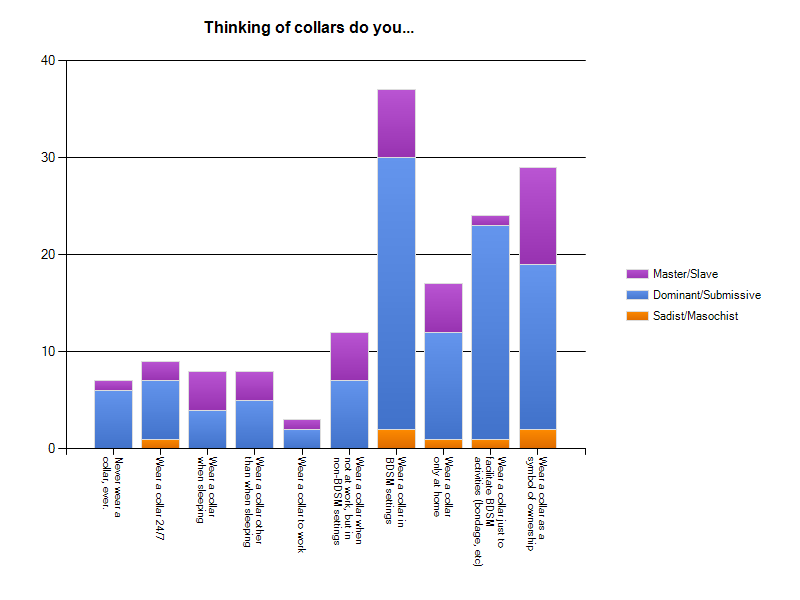
Half of the masochists (two people) said they wore a collar as a symbol of ownership. 35% of submissives and 67% of slaves said they wore a collar as a symbol of ownership. None of the masochist respondents said they “Never wear a collar, ever” whilst 12% of submissives and seven per cent of slaves said they never wear a collar.
Clicking on this image opens a larger one which may be more easily readable.
24/7?
25% of masochists (Okay – one person) said they wear a collar all the time, compared to 12% and 13%, respectively, of submissives and slaves. This contrasts with those who wear a collar just for BDSM purposes – 25% of masochists, 45% of submissives and 7% (that’s just one person) of slaves do this.
I’ve found myself telling this story to people on several occasions because it seems to illustrate something that is, to me fundamental to my understanding of the nature of submission. But, before the story, a bit of a ramble about submissive wilfulness and resistance.
I have let myself down badly in the past by not understanding wilfulness and resistance and finding ways through it: In fact this issue destroyed, a few years ago, what was, otherwise, a promising relationship with all the lifestyle M/s content we desired. I have a pretty rigid view on how to deal with resistance to submission and I know I may have put on an unhelpful set of blinkers.
First, my s and I will share a clear set of goals (moveable through agreement) and a basic set of attitudes towards D/s issues: If we didn’t, why would we have even bothered to start anything?
Secondly, I expect to lead her on our journey and to need to deal with her feelings of fear, nervousness, excitement, perhaps disgust – maybe anger (but hopefully not) by picking a careful route through the brambles and observing and understanding her sufficiently to know which doors to unlock first, so that it becomes easier and easier to reach those things that are at the core of our needs – and which are, at first, out of reach.
I’ll listen so that I may understand her, I’ll watch her behaviour to do the same – and all so I can get the relationship to where I want it to be, confident that she really wants it to go there too (I should know this because we communicate and I observe, or try to).
I’ll use observation, discussion, experience, reward, punishment and more observation to bring her to the point where she gifts me that part of her that I want – and which takes us a step further on our journey together.
But, from that point on, in any area where she has given me the gift of control (having experienced the consequences of that control and having given her informed consent) I cannot tolerate wilfulness: Once she has given me the right to control an aspect of her life – then she has no right to resist my use of it. To resist, just occasionally, demands punishment and then discussion and explanation to make sure it does not happen again and if there are issues I’ve not understood or resolved then these must be settled.
To resist control, in an area which has been willingly given, more than once in a very long while undermines the dynamic and damages the relationship deeply. To understand that and still resist, destroys the relationship.
Such resistance seems to me to be a basic function either of not understanding each other at the outset of the journey, or a symptom of change that has rendered the partners’ D/s motives incompatible. In either case, I’d not waste much time trying to resurrect things once a trend of willful disobedience has emerged.
Informed consent should be followed by informed obedience, in my view.
Now, the story of the stag party.
In my mid late twenties, many of my former school friends found girls and got married. We’d been scattered to the four winds by our careers and the stag nights that brought us back together invariably became occasions for much re-buddying and reminiscence. And teasing.
There was this one night. We’d met and had a few beers. We’d gone bowling (and had a few beers). To the dogs (and – oh, you get the picture).
(Photo credit: Wikipedia)
I seem to remember that after the curry, during the lock-in (and before the naked best man and groom race down a cobbled street one frozen February morning – which had calamitous consequences, but that’s another story) someone turned the topic to sex after marriage – and, specifically, masturbation.
One by one every married chap there confessed that he resorted to a hand-shandy far more often after wedlock than he’d needed to in the months and years before (except of course when ovulation was due).
Well, as Frankie Howerd might have said, “I was ammaaaazzzeeeed”.
Cos that wasn’t my experience of life. Yes, her indoors was not necessarily always up for a night of rampant rumpy-pumpy. But she was very considerate of my needs and, mostly, the slightest hint of an erection would be enough to bring solicitous enquiries about his welfare and whether he might need relief. She knew I adored her for this. But up until that night, I did not really realise how much she deserved to be adored for this focus on me – which happened because it made me feel wanted and made her feel needed.
For me, dominance and submission are opposite sides of a single coin: meeting your partner’s needs.
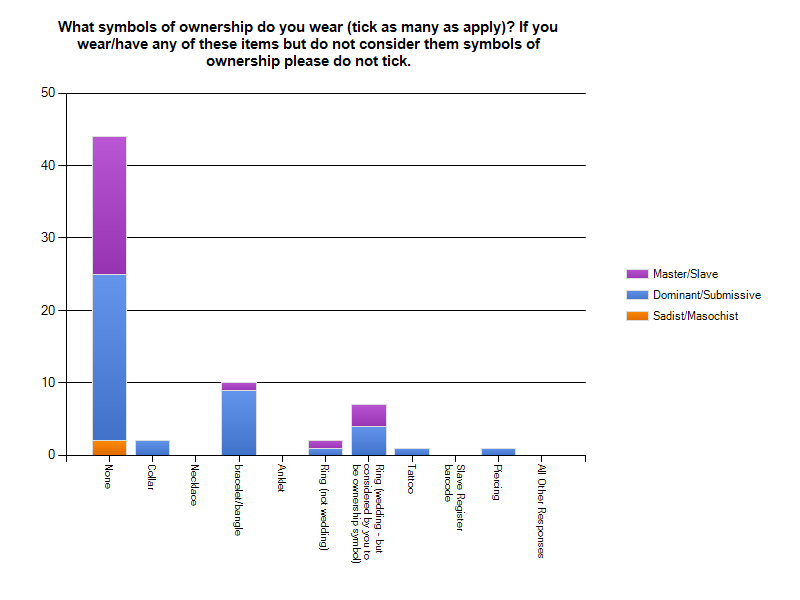
I’ve published that list before on Informed Consent. The charts below are new. They show what respondents said they wore as symbols of ownership. It was possible to choose more than one item, so percentages don’t add up to 100!
Dominants and symbols of ownership
The chart below shows what dominant respondents said they wore (not what their partners wore) as symbols of ownership, it looks at dominants of all BDSM components.
Overall. 73% of all dominants said they wore no symbols of ownership. All S/m dominants said they wore no symbols of ownership (to be fair, that was just two individuals). 66% of D/s dominants said they wore nothing (23 respondents). 86% of M/s Dominants wear no symbol of ownership (19 people).
The most common symbol of ownership worn by dominant respondents was a bracelet or bangle (17% said they wore this), followed by a wedding ring (12%).
Submissives – what do they wear?
74 submissives answered this question. As a symbol of ownership, the collar came top. 68% of all the submissives that answered this question said they wore a collar. 80% of S/m submissive respondents wear a collar to show ownership (4 people). 60% (31 respondents) of D/s submissives said they wear a collar and 88% (15 answerers) of M/s submissives also said they wear a collar to signify ownership.
26% of submissives wear no symbols of ownership.
24% of all respondents say they wear a bracelet/bangle – the second most common symbol of ownership. 25% of D/s respondents and 30% of M/s respondents wear this (no M/s respondents).
The third most common symbol of ownership worn by submissives is the tattoo, worn by 22% overall and 21% of D/s submissive respondents and 29% of M/s submissives who answered. Necklaces were fourth, but not far behind, being worn by 20% of submissive respondents.
Amongst submissive respondents rings (not wedding), at 11% were more common as ownership symbols than wedding rings (7%).
This, my first article on this blog, relates to a survey I did of “Informed Consent” users looking at the symbols, like collars, that they use to display their relationship status and to get an idea of how they regard theses symbols.
Your views on “ownership” – just one selection please, whichever you think most represents your views
Across the entire sample (broken down by principle BDSM orientation) answers were as follows:
Your views on “ownership” – just one selection please, whichever you think most represents your views
Answer Options
Sadist Masochist
Dominant Submissive
Master Slave
Response Percent
I consider myself owned or possessed by my partner
1
26
20
27%
I own or possess my partner
0
9
17
15%
I am in a BDSM relationship but do not consider myself or my partner to be owned.
2
7
1
6%
I believe BDSM ownership is possible
5
18
5
16%
I don’t think BDSM ownership is possible
19
6
0
14%
I believe that there are specific times and occasions when a person in a BDSM dynamic can be owned by their partner
4
27
0
18%
I believe a person can be owned by a person not their partner for a specific time or activity
4
4
0
5%
Answered question
175
Skipped question
29
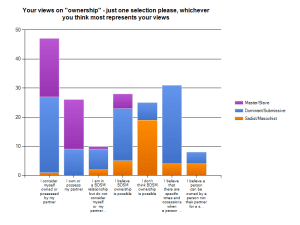
This data also appears in the column chart below. What stood out for me was the large proportion of people who characterise themselves as either Dominant/submissive (D/s) or Master/slave (M/s) who are in a relationship they characterise as ownership or possession, or who think this is possible. compared to the high proportion of Sadists/masochists (S/m) who don’t think BDSM ownership is possible.

 In the survey I did of BDSM symbols and ownership, promoted through my blog and posts on the website Informed Consent, I asked about people’s collar-wearing habits.



 A dominant and submissive life